Politics in the Gilded Age: Corruption, Prosperity, and Economic Regulation
The Gilded Age, a term denoting a superficial layer of prosperity masking deep societal issues, was characterized by significant corruption and poverty. With a laissez-faire economic approach, the government played a minimal role in business, leading to rampant bribery and favoritism. Key legislation like the Pendleton Service Act aimed to address civil service corruption, while blue laws reflected moral divisions between political parties. Significant court cases and acts, such as the Interstate Commerce Act, sought to regulate railroads, highlighting the struggle for fairness in an uneven economic landscape.

Politics in the Gilded Age: Corruption, Prosperity, and Economic Regulation
E N D
Presentation Transcript
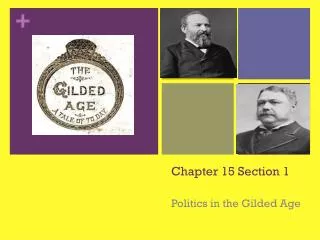
Chapter 15 Section 1 Politics in the Gilded Age
Gilded Age • Gilded means covered with a thin layer of gold • Gilded Age suggests that a thin but glittering layer of prosperity covered the poverty and corruption of much of society
Is the term Gilded Age a positive or negative description of this period? Explain • Negative • It suggests that the positive and prosperous aspects of society were a thin, golden layer masking numerous problems, such as poverty and corruption
Laissez Faire • A hands off approach to economic matters • Government should play a very limited role in business • Supporters would say that if government stays out of the way, strong businesses will succeed and bring wealth to the entire nation
Subsidy • A payment made by the government to encourage the development of certain key industries, such as railroads • To ensure government aid, some business owners would support friendly politicians with bribes
What is the purpose of a subsidy? • To promote the expansion of industries deemed essential by the government.
Blue Law • Regulations that prohibited certain private activities that some people considered immoral • Republicans supported these laws, Democrats did not • Blue laws were just one of many issues that divided Republicans and Democrats
Civil Service • The government’s nonelected workers • Very corrupt during the Gilded Age • Many civil service workers hired because they had powerful friends, bribed the right person, or made a campaign contribution to the right politician..rarely hired because they were qualified
Pendleton Service Act • Passed in 1883 • Created a Civil Service Commission which tested how qualified applicants were for Civil Service jobs • Signed into law by President Chester Arthur
Rebate • Partial refunds to favored customers • This would give an advantage to one business over another when it comes to railroad transportation • RRs would also keep rates secret so they could charge whatever they wanted or charge more for short hauls than long hauls
Munn v. Illinois • 1877 Supreme Court Case • Allowed states to regulate certain businesses inside their borders (including railroads) • However, this does not regulate interstate railroad traffic • Corruption could still exist there
How did the Interstate Commerce Act affect railroads? • It required railroads to set rates according to distance and to make rates public and universal for all customers