Download
1 / 22
220 likes | 328 Vues
Explore the fascinating world of the skeletal and muscular systems. Learn what bones are made of, the role of bone marrow, and the different types of bones. Discover the importance of calcium and how muscles contract and relax in pairs. Understand tendon functions and the characteristics of skeletal, cardiac, and smooth muscles. Recognize voluntary and involuntary movements, and how joints and ligaments work together to facilitate movement in the body. This comprehensive overview provides insights into how our bones and muscles work harmoniously.

E N D
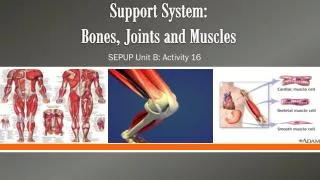
Support System: Bones, Joints and Muscles SEPUP Unit B: Activity 16
Muscles • Made of muscle cells. • Contract and relax. • Contraction causes muscles to shorten. • Work in pairs.
Do this…. • Hold your arm out straight. • Feel what the muscles are doing when you bend it toward your face. • Feel the biceps and the triceps muscles.
Tendons • Silvery, shiny tissue. • Attach muscle to the bone. • Tendons attach muscles to bones so that bones can move.
Types of muscles? • Skeletal muscles. • Cardiac muscles. • Smooth muscles.
Characteristics of Skeletal Muscle? • Attach to bones for movement and to protect inner organs. • Bundles of muscle fibers are surrounded by a connective sheath. • Muscle cells are striated (striped) depending on how much actin and myosin they contain. • Movement of skeletal muscles is voluntary.
Characteristics of Cardiac Muscle? • Found only in the heart. • Can beat or pulse on their own. • When cardiac muscle cells touch each other they beat together. • Has characteristics of Smooth and Skeletal muscle. • Are involuntary (like smooth muscle). • Striated like skeletal muscle.
Characteristics of Smooth Muscle? • Found in the walls of hollow organs like the digestive tract and walls of blood vessels. • Cells are thin and long. • They form sheets rather than bundles. • Control slow, involuntary movement.
Examples of Smooth Muscle Movements? • Contraction of the walls of the stomach and intestines. • Contraction of arteries to regulate the blood pressure and the flow of blood.
Voluntary and Involuntary Movements? • Voluntary – Actions that are under your control. • Involuntary – Actions that are not under your control.
Voluntary: Actions that are under your control. • Skeletal muscles – walking, talking, bending.
Involuntary: Actions that are not under your control. • Smooth and Cardiac muscles – breathing, digesting, heart beating. http://vimeo.com/8321006
Joints and Ligaments • Joint - Place where two bones meet. • Ligaments connect one bone to another bone. • Ligaments stabilize the joint and allow it to move.
How do muscles, joints and bones work? • The skeletal/muscle system works like a lever.