Mastering Time Value of Money: PV, FV, PMT Calculations
Learn how to calculate present value, future value, and payments with comprehensive examples and financial calculator tips. Explore compound interest, annuities, and discounted cash flows.

Mastering Time Value of Money: PV, FV, PMT Calculations
E N D
Presentation Transcript
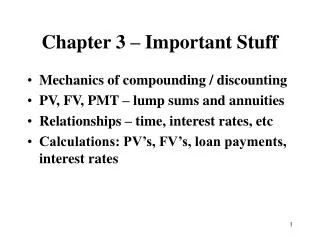
Chapter 3 – Important Stuff • Mechanics of compounding / discounting • PV, FV, PMT – lump sums and annuities • Relationships – time, interest rates, etc • Calculations: PV’s, FV’s, loan payments, interest rates
Time Value of Money (TVM) • Time Value of Money – relationship between value at two points in time • Today versus tomorrow; today versus yesterday • Because an invested dollar can earn interest, its future value is greater than today’s value • Problem types: monthly loan payments, growth of savings account; time to goal
Financial Calculator Keys • PV - Present value • FV - Future value • PMT - Amount of the payment • N - Number of periods (years?) • I/Y - Interest rate per period
TI Calculator ManualStrongly Suggested Readings • Getting Started – page 6 and 7 • Overview – page 1-4, 1-10 and 1-20 • Worksheets – pages 2-14 and 2-15 • TVM – 3-1 to 3-9
Calculator Tips Decimals and Compounding Periods • 2nd (gray), Format (bottom row), 4, enter, CE/C (lower left) - hit twice • Compounding: 2nd , I/Y, 1, enter, CE/C – extremely important !! • Right arrow key fixes “misteaks” • One cash flow must be negative or error
Concept of Compounding • Compound Interest – basically interest paid on interest • Takes interest earned on an investment and reinvests it • Earn interest on the principal and reinvested interest
Compound Interest @ 6% YearBeginInterestFutureVal 1 $100.00 $6.00 $106.00 2 106.00 6.36 112.36 3 112.36 6.74 119.10
Future Value (FV) Algebraically FVn = PV (1 + i)n Underlies all TVM calculations Keystrokes: 100 +/- PV; 3 N; 0 PMT; 6 I/Y; CPT FV = 119.10 One cash flow must be negative
FV – Other Keystrokes • How long for an investment to grow from $15,444 to $20,000 if earn 9% when compounded annually? Must solve for N. • 15444 +/- PV; 20000 FV; 0 PMT; I/Y 9; CPT N = 3 years • What rate earned if start at $15,444 to reach $20,000 in 3 years? Solve for I/Y. • 15444 +/- PV; 20000 FV; 0 PMT; 3 N; CPT I/Y = 9%
Future Value Interest Factor Year@2%@6%@10% • 1.020 1.060 1.100 • 1.040 1.124 1.210 3 1.104 1.191 1.611 10 1.219 1.791 2.594
FV Can Be Increased By 1. Increasing the length of time it is compounded 2. Compounding at a higher rate And/or 3. Compounding more frequently
Present Value (PV) If I earn 10%, how much must I deposit today to have $100 in three years? $75.10 This is “inverse compounding” Discount rate – interest rate used to bring (discount) future money back to present For lump sums (only) PV and FV are reciprocals
Present Value Interest Factor @2%@5%@10% Year 1 .980 .952 .909 Year 2 .961 .907 .826 Year 3 .942 .864 .751 Year 10 .820 .614 .386
Present Value Formula [ 1 ] PV = FVn[ (1 + i) n ] PVIF and FVIF for lump sums only are reciprocals. For 5% over ten years FVIF = 1.629 = 1 / .614 PVIF = .614 = 1 / 1.629
Keystrokes$100 @5% for ten years • For PV 100 FV; 0 PMT; 5 I/Y; 10 N; CPT PV = 61.39 • For I/Y 100 FV; 0 PMT; +/-61.39 PV; 10 N; CPT I/Y = 5 • For N 100 FV; +/-61.39 PV; 0 PMT; 5 I/Y; CPT N = 10 years
PV Decreases If • Number of compounding periods (time) increases, • The discount rate increases, And/or 3. Compounding frequency increases
Annuities • Series of equal dollar payments • Usually at the end of the year/period • If I deposit $100 in the bank each year starting a year from now, how much will I have at the end of three years if I earn 6%? $318.36 • We are solving for the FV of the series by summing FV of each payment.
FV of $100 Annuity @ 6% End of PMTFVIF $ Year 3 $100 1.0000 * $100.00 Year 2 100 1.0600 106.00 Year 1 100 1.1236 112.36 $318.36 * The payment at end Year 3 earns nothing
Annuity Keystrokes What will I have if deposit $100 per year starting at the end of the year for three years and earn 6%? 0 PV; 100+/- PMT; 3 N; 6 I/Y; CPT FV = 318.36 PV is zero - nothing in the bank today
Present Value of an Annuity Amount we must put in bank today to withdraw $500 at end of next three years with nothing left at the end? Present valuing each of three payments Keystrokes: 500+/- PMT; 0 FV; 3 N; 6 I/Y; CPT PV = 1,336.51
Nonannual Compounding • Invest for ten years at 12% compounded quarterly. What are we really doing? • Investing for 40 periods (10 * 4) at 3% (12%/4) • Make sure 2nd I/Y is set to 1. • Need to adjust rate per period downward which is offset by increase in N
Nonannual Compounding • FVn = PV ( 1 = i/m) m * n • m = number of compounding periods per year so per period rate is i/m • And m * n is the number of years times the compounding frequency which adjusts to the rate per period
Compounding $100 @10% CompoundingOne Year10 Years Annually $110.00 $259.37 Semiannually 110.25 265.33 Quarterly 110.38 268.51 Monthly 110.47 270.70
Amortizing Loans • Paid off in equal installments • Makes it an annuity • Payment pays interest first, remainder goes to principal (which declines) • $600 loan at 15% over four years with equal annual payments of $210.16
$600 Loan Amortization TotalTo IntTo PrinEnd Bal Year 1 210.16 90.00 120.16 479.84 Year 2 210.16 71.98 138.18 341.66 Year 3 210.16 51.25 158.91 182.75 Year 4 210.16 27.41 182.75 0
Calculate a Loan Payment • $8,000 car loan payable monthly over three years at 12%. What is your payment? How many monthly periods in 3 yrs? 36 N Monthly rate? 12%/12 = 1%/mo = I/Y What is FV? Zero because loan paid out 8000+/- PV; 0 FV; 1.0 I/Y; 36 N; CPT PMT=265.71
Perpetuities • Equal payments that continue forever • Like Energizer Bunny and preferred stock • Present Value = Payment Amount Interest Rate Preferred stock pays $8/yr, int rate- 10% Payment fixed at $8/ .10 = $80 market price