Download
1 / 17
170 likes | 286 Vues
This work explores the intricate relationship between technical progress and economic principles, revealing how innovation fuels development. Historical perspectives from notable figures, such as Marshal Foch and Thomas Watson, highlight initial skepticism towards technological advancements that later became indispensable. The evolution of innovation is dissected into three stages: invention, innovation, and diffusion. Modern entrepreneurs who effectively merge scientific achievements with economic strategies exemplify successful market leaders, pushing society toward rapid advancement through international diffusion of technology.

E N D
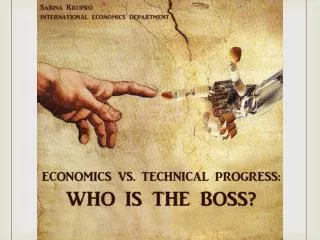
Does technical progress rule economics or other way round? In the past… …now
1901 The airplanes are amusing toys, but they are worthless for military objectives. French marshal Ferdinand Foch 1943 I think there is a world market for maybe five computers.chairman of IBM Thomas Watson on seeing the first mainframe computer
As for economically sound the names of technical progress innovators are often unimportant.
Nowadays market winners are people who • can ably unite scientific achievements and economical principles • take the lead • can combine factors of production in new special way • clearly understand the significance of technical progress and can efficiently motivate it
entrepreneurs These people are
Uniting both technical progress and economics we get difficult process which is divided into three stages:
The creation of new product or production technique and receipt/receiving the first proof of its viability is the invention. What if…?
The innovation is the first successful adoption of a new product, new production technique or creation of new business forms.
The last stage is diffusion when companies start to copy the most successful innovations.
International diffusion of technical progress enable to develop our world as fast as it can possibly happen.