
Islamic Art
E N D
Presentation Transcript
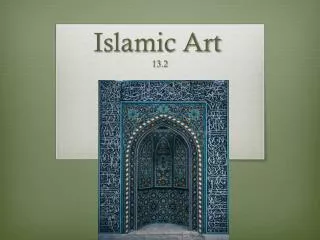
Islamic Art 13.2
Islam & Muhammad • In the 7th century AD, a religion known as Islam (which means followers of God’s will) emerged in the Middle East. • The Prophet of Islam was an Arab merchant named Muhammad, who was born in Mecca around 570AD. • Following the death of his parents, Muhammad was raised by an uncle. As a hard working young trader, Muhammad learned the habits and languages of the wandering Arabs. • His fortunes improved following his marriage to a wealthy widow, whose business he tended. • During this time Muhammad received personal revelations that forced him to challenge superstitions of the Arabs, who worshipped many different idols.
The Teachings of Muhammad • Following years of meditation, Muhammad heard a divine call to be the last of the prophets and a teacher for all. • He taught that there is only one god. Allah (in Arabic “The God”), whose will should be followed in order for people to live just and responsible lives. • At first Muhammad taught in secret, converting his wife, cousin, and adopted son. • When he began to teach openly he was opposed by those who wished to preserve established tribal and religious customs. • He persisted and today there are more than 925 million followers, called Muslims. • Muslims regard Muhammad as one of the last great prophets and as their guide, the Messenger of God.
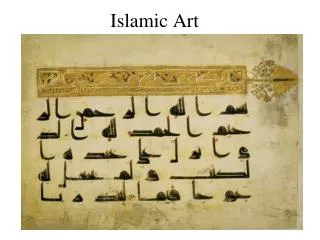
The Koran • After Muhammad’s death, messages he received from God were assembled into the Koran. • Koran or Qur’an – the holy scripture of Islam • For Muslims the Koran is the final authority in matters of faith. It also offers rules for daily life of Muslims. • A page from a Koran during the 14th century shows the skill with which Muslim artists used a decorative script to record Muhammad’s accounts. Page from a 14th Century Koran
Islamic Art in the Fertile Crescent • During the early centuries of Islamic history, the center of the Muslim world was an area known as the Fertile Crescent, composed of present day Iraq, Syria, and Palestine. • Here the constant blending of Eastern and Western cultures had left a stunning array of magnificent ruins. • To these ruins, Muslim builders soon added their own impressive structures. Included among these was the mosque, or Muslim place of worship.
The Mosque of Al-Mutawakkil • In the 9th century the largest mosque was built in at Samarra in Iraq. • Measuring 384 by 512ft, it covered 10 acres and could hold 100,000 worshippers . • Today little remains of the huge prayer hall. Only traces of the 464 brick columns that once supported the flat, wooden, roof can be seen. • However a minaret, a tower attached to a mosque, still stands. From the top of the tower a prayer caller once summoned people to group worship each Friday.
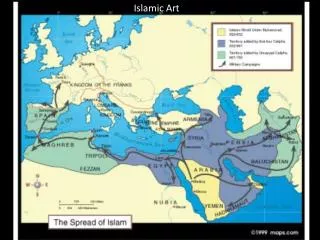
Islamic Art in Spain • By 710, the religion of Islam had spread throughout North Africa, at times by persecution and at by times by force. • In 711, Muslims crossed the Strait of Gibraltar and entered Spain. • The Muslim army advanced swiftly through Spain, encountering little resistance. • After their advances into France were repelled, the Muslims did not attempt additional invasions. Instead they consolidated their control of Spain and some other parts in southern Europe. • The Muslims known as Moors in Spain, remained on the Iberian peninsula for almost 800 years. • At the height of the Moorish power in Spain, the city of Cordoba was one of Islam’s most impressive capitals. • People from all over Europe came for enlightenment and knowledge. • In contrast to many other cities in Europe, Cordoba was a great city of learning and the arts. All that survives today however are the remains of a fortress, -and the great mosque known as the Mezquita.
The Mezquita • The ancient brown walls of the Mezquita, marked by sealed, arched entries, offer little hint of pleasures that await inside. • Within these walls, however, lies a courtyard known as the Patio of the Orange Trees. • Originally no walls separated this courtyard and the interior of the mosque. • The courtyard and the mosque were linked by the lines of orange trees outside and the rows of columns inside.
Muslim Worship • Muslims worship five times a day: at sunrise, noon, afternoon, sunset, and evening. • Private prayers can be offered anywhere, but group prayer takes place in the mosque at noon on Fridays. • In Moorish times, preparing for a group worship involved ceremonial bathing. • The fountains in the Patio of the Orange Trees were used for this bathing. • In contrast to the courtyard, the mosque interior is dark.
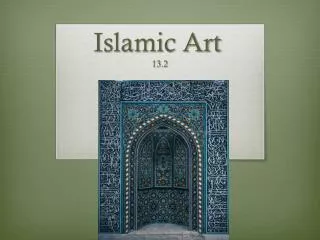
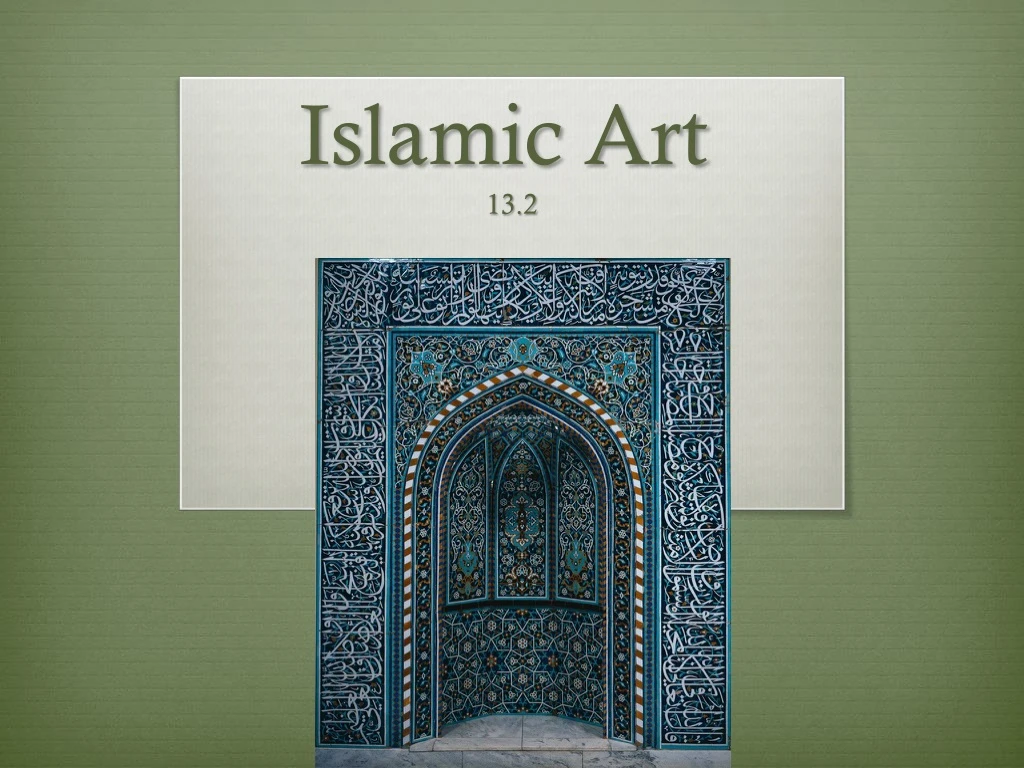
Mosque Interiors • The interior of Islamic mosques are unlike interiors of Christian churches. • Christian artists created religious images as a ways of teaching the religion to people who could not read. • Islamic artists avoided portraying living creatures in mosques and other religious buildings, because they did not want it to diminish the greatness of God’s creative power by portraying such forms. • Instead these artists decorated mosques and other religious structures with ornate calligraphy, geometric patterns, and stylized plants and flowers.
Madinataz-Zahra • Not far from Cordoba, a Moorish ruler erected a palace. • When it was completed, it was like no other place in the world – an entire self-contained city extended upward in three levels: a mosque below, gardens in the center, and an alcazar, or fortified palace at the top. • Covered an entire hillside and had more than 400 rooms, hundreds of fountains, and 4000 columns that supported a massive roof.