Mastering Rhetoric: The Art of Persuasive Argumentation in Writing and Speaking
Rhetoric is the art of using language effectively to persuade audiences in writing and speaking. This essay delves into argumentation and persuasion, outlining the process of crafting persuasive essays that target specific audiences and address key issues. Readers will learn about the importance of a well-constructed thesis, the organization of arguments, and the use of logical (logos), emotional (pathos), and ethical (ethos) appeals. With insights on audience awareness, methods of reasoning, and various modes of discourse, this guide offers practical strategies for effective persuasion.

Mastering Rhetoric: The Art of Persuasive Argumentation in Writing and Speaking
E N D
Presentation Transcript
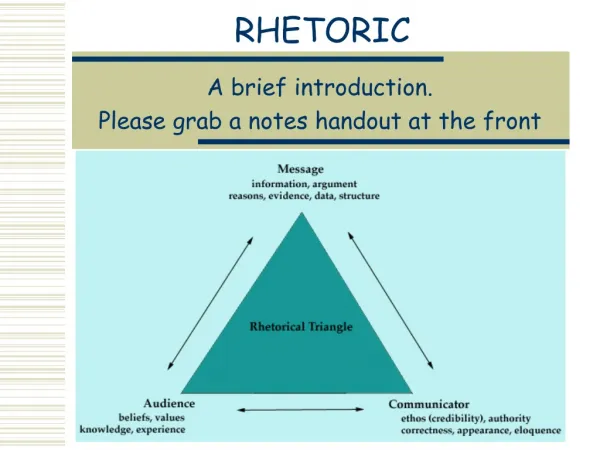
Rhetoric The art of using words to persuade in writing or speaking.
Argumentation or Persuasion • An essay that addresses a specific purpose • Has a targeted audience • Requires reasoning • An effective argument is a well-constructed presentation of ideas that takes a stand about an issue. • Often this is called a claim or thesis statement • Is supported with various evidence or premises
Methods of organization • Order of importance • Chain of reasoning • Cause and effect • Rebuttal • Concession/refutation • Process analysis
Writers will use the various modes of discourse to support their claims with a combination of both logical (logos) and emotional (pathos) evidence to establish their credibility as writers or their ethical appeal (ethos).
Four Modes of Discourse • Description • Depicts images verbally in space and time • Narration • Tells a story or relates an event • Exposition • Informs, instructs, or presents ideas/truths • Argumentation • Convinces, proves, or refutes a point of view or issue
Elements of Argumentation • Purpose • Audience • Appeals of Logic, Emotion, and Ethics • Classical Structure • Introductory Paragraph • Concession and Refutation • Confirmation Paragraphs • Concluding Paragraph
PURPOSE: might be to • Support a cause • Promote a change • Refute a theory • Stimulate interest • Win agreement • Arouse sympathy • Provoke anger
AUDIENCE: writer’s targeted readers • Who is exactly is the audience? • What do they know? • What do they believe? • What do they expect? • How will the audience disagree with me? • What will they want me to address or answer: • How can I—or should I—use jargon? • Should I use language that is formal, factual, and objective—or familiar, anecdotal, and personal?
Appeals of Logic, Emotion, and Ethics • Types of Logical Appeals (logos) • Emotional Appeals (pathos) • Ethical Appeal (ethos)
Logos (logic) • Incorporate inductive reasoning. • Use deductive reasoning • Create a syllogism • Cite traditional culture • Cite commonly held beliefs • Allude to history, religious texts, great literature, or mythology • Manipulate the style. • Employ various modes of discourse for specific effects
Logos, cont. • Provide testimony • Draw analogies/create metaphors • Order chronologically • Provide evidence • Classify evidence • Cite authorities • Quote research • Use facts • Theorize about cause and effect • Argue from precedent
Pathos (emotional appeal) • Use language that involves the senses. • Include a bias or prejudice • Include an anecdote • Include connotative language • Explore euphemisms • Use description • Use figurative language • Develop tone • Experiment with informal language
Ethos (ethical appeal) • Show written voice in the argument • Make the audience believe that the writer is trustworthy • Demonstrate that the writer put in research time • Support reasons with appropriate, logical evidence
Ethos, cont. • Present a carefully crafted and edited argument • Demonstrate that the writer knows the audience and respects them • Show concern about communicating with the audience • Convince the audience that the writer is reliable and knowledgeable