
Sound Perception and Auditory Pathways
E N D
Presentation Transcript
Audition (Hearing) • Transduction of physical sound waves into brain activity via the ear. • Sound is perceptual and subjective. • Structure of the ear. • Pathways from the ear to the cortex. • MGN (medial geniculate nucleus of the thalamus)
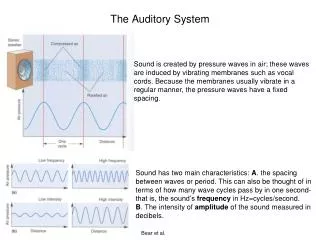
The Nature of Sound • When displaced by a moving object, air becomes compressed. • Vibrations produce periodic patches of compressed air. • Frequency is the number of such patches per second (Hz). • Intensity is the amount of air pressure (dB, decibels).
Low Frequency High Frequency Physics of Sound Frequency – Number of cycles completed by a wave in a given amount of time
High Amplitude Low Amplitude Physics of Sound Amplitude – Physical strength of a wave
Pitch, Loudness, and Timbre Pitch – Sensory characteristic of sound produced by the frequency of the sound wave Loudness– Sensory characteristic of sound produced by the amplitude (intensity) of the sound wave Timbre – Quality of a sound wave that derives from the wave’s complexity
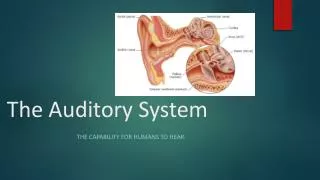
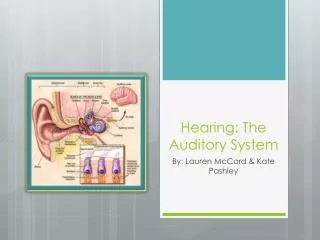
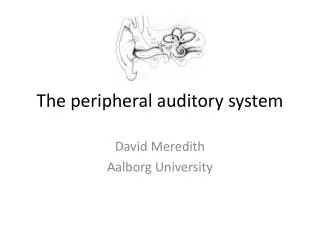
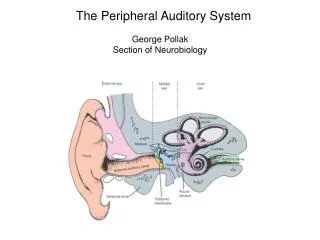
Anatomy of Auditory Perception • Outer ear – directs sound waves to tympanic membrane, pinna localizes sound. • Middle ear – amplifies the wave and transmits it to the fluid-filled inner ear. • Eustachian tube – equalizes pressure and protects ear from loud noise • Inner ear – cochlea transduces sound waves into neural signals.
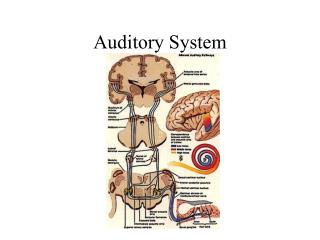
Auditory Pathways • Auditory receptors in cochlea exit via auditory nerve. • Brain stem neurons at superior olive permit sound localization. • Separate pathways for each ear up the brain stem. • MGN • Auditory cortex
Tonotopy • Portions of the basilar membrane and frequency selective. • Frequencies maintain their relation to each other in the MGN and auditory cortex. • Phase locking represents low frequencies, tonotopy and phase locking both represent mid level frequencies, tonotopy alone is useful at highest levels.
Attenuation Reflex • Muscles contract to make the ossicles more rigid, reducing sound transmission to the inner ear – protects the ear. • Operates more at low frequencies. • Prevents saturation, making high frequency sounds more discernible. • Makes speech easier to understand in a noisy environment.
Sound Localization • Interaural time delay • Detected at superior olive • Works at low frequencies • Interaural intensity difference (sound shadows) • Works at high frequencies • Pinna localizes sounds vertically (from above and below)