Download

1 / 23
230 likes | 348 Vues
Drop-in tutoring hours are available Monday to Thursday from 4-10 PM in Baskin 379. Homework is due at the end of class on Monday, and must be stapled with your name, TA's name, and section information. There are also changes to section times and locations: M/W 8-9:50 AM with Wenyi is now 4-5:50 PM in Baskin 360; Tu/Th 8-9:50 AM with Deboja is now 6-7:50 PM in Baskin 295; M/W 5-6:50 PM with Shubhra has been adjusted by 10 minutes to 5:10-7:00 PM.

E N D
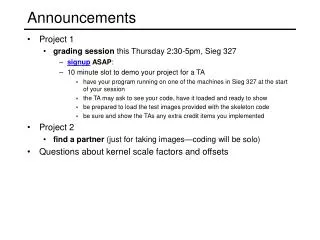
ANNOUNCEMENTS Drop in tutor hours: M-Tu-W-Th 4-10pm, Baskin 379 Homework due Monday at end of class. Stapled, name of student and name of TA and section you attend.
ANNOUNCEMENTS SECTIONS CHANGE OF TIMES/LOCATION M/W 8-9:50am section with Wenyi moved to M/W 4-5:50 in Baskin 360. Tu/Th 8-9:50am section with Deboja moved to M/W 6-7:50 in Baskin 295 M/W 5-6:50pm section with Shubhra moved by 10 minutes to M/W 5:10-7:00pm
II.1 the concept of variables II.1.1 introduction the ultimate scientific aim is to understand causal links between events: WHY ? or HOW ?
methods used to achieve that aim: • measurement • analysis • modeling • prediction • control
measurement & analysis • all experiments/measurements provides data • human brain specifically designed to process images efficiently analysis usually involves graphic representation of data.
examples one quantity measured as a function of another
examples one quantity measured as a function of another
examples two quantities measured as a function of another
examples one quantity measured as a function of two others
examples one quantity measured as a function of two others
examples one quantity measured as a function of two others
examples one quantity measured as a function of three others
Examples one quantity measured as a function of three others
modeling to model and study complex problems one needs a rigorous mathematical framework
II.1.2 definitions • independent variables: control parameters, the quantities that can be varied at will. • dependent variables: the quantities that change as a consequence of the independent variable being varied.
II.2 Graphing 2 possible scales: linear and logarithmic II.2.1 the linear scale • use it when the variable has small range • the interval [a,b] has the same length as the interval [a+c,b+c]
II.2.1 the logarithmic scale • use it when the variable has large range • the interval [a,b] has the same length as the interval [a x c, b x c]
3 example types of plots • linear - linear
3 example types of plots • log - linear
3 example types of plots • log - log