Understanding the Central Dogma: From DNA to Proteins
This guide explores the Central Dogma of molecular biology, detailing the processes of DNA replication, transcription, and translation. It illustrates how DNA is used to synthesize proteins through a series of critical steps occurring in the cell. Key topics include the roles of mRNA, tRNA, and rRNA in gene expression. The guide summarizes how enzymes like RNA polymerase facilitate transcription in the nucleus, leading to the formation of mRNA, which is then translated into amino acids at the ribosome. Essential for understanding genetics and protein synthesis.

Understanding the Central Dogma: From DNA to Proteins
E N D
Presentation Transcript
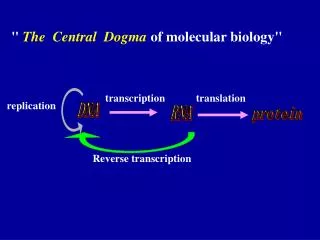
The Central Dogma • DNA • Transcription • RNA • Translation • Proteins
replication transcription translation GOAL • Use DNA to make a Protein • Step 1: Replicate DNA • Step 2: Transcribe DNA into RNA • Step 3: Translate RNA into a protein • Where does this happen? • Step 1: Nucleus • Step 2: Nucleus • Step 3: Cytoplasm Ribosomes
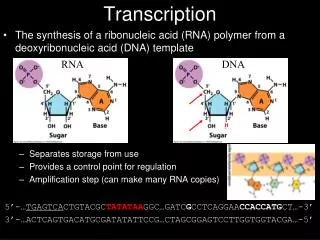
RNA vs. DNA DNA RNA Sugar: Ribose Bases: A,U,C,G Single Stranded • Sugar: Deoxyribose • Bases: A,T,C,G • Double Stranded
RNA • Stands for: Ribonucleic Acid • Three Types: • mRNA • Carries the message from the DNA to the ribosome • tRNA • Brings amino acids from the cytoplasm to the ribosome • rRNA • Makes up part of the ribosome
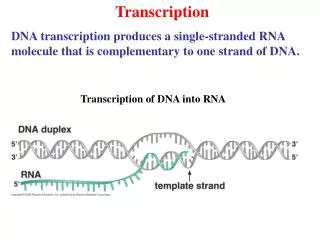
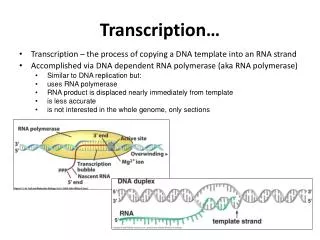
Transcription Basics • Process of taking DNA and turning it into RNA • Uses enzymes: Chemical Reaction • Happens in the nucleus
RNA Polymerase start site nucleotides Transcription • Starts because of an enzyme called RNA polymerase • This enzyme starts to unwind the DNA at the start of a gene • Nucleotides pair with ONE strand of DNA • RNA Polymerase (enzyme) bonds them together DNA molecule
mRNA Transcription • DNA winds back up • mRNA detaches and leaves the nucleus
Transcription vs Replication Similarities • Both involve enzymes • Both pair the matching bases together • Happens in the nucleus
Transcription Only copies ONE gene Only copies ONE side A will match with U instead of T Final Product: mRNA Replication Copies the ENTIRE strand Copies BOTH sides A will match with T Final Product: Same thing you started with (DNA) Transcription vs Replication Differences
Goal of Translation • Convert mRNA into amino acids that will end up building a protein • Proteins are polymers of amino acids
codon for methionine (Met) codon for leucine (Leu) Amino acids are coded by mRNA base sequences. • Codons are three letters words • There are 64 different codons • Each word means (translates) into ONE of the AMINO ACIDS
Codons Review: Codon=3 nucleotides that are read together. If this is the strand of mRNA: UCGCACGGU The codons are: UCG-CAC-GGU How many codons are there? 3
The genetic code matches each codon to its amino acid or function. • There are 20 Amino Acids
Amino acids are linked to become a protein • An anticodon is a set of three nucleotides that is complementary to an mRNA codon. • An anticodon is carried by a tRNA.
Your Turn Strand of mRNA: AUGCGUACCUUAUAA What are the codons? AUG-CGU-ACC-UUA-UAA What are the anticodons? UAC-GCA-UGG-AAU-AUU
tRNA carries amino acid to ribosome • ribosome forms bonds between the amino acids.
Important Notes • Start: ALWAYS start with codon AUG • What amino acid will you always start with? • Methionine (AUG) • End: ALWAYS end with a STOP • Which codons will that be? • UAA, UAG, UGA