What is a synapsis
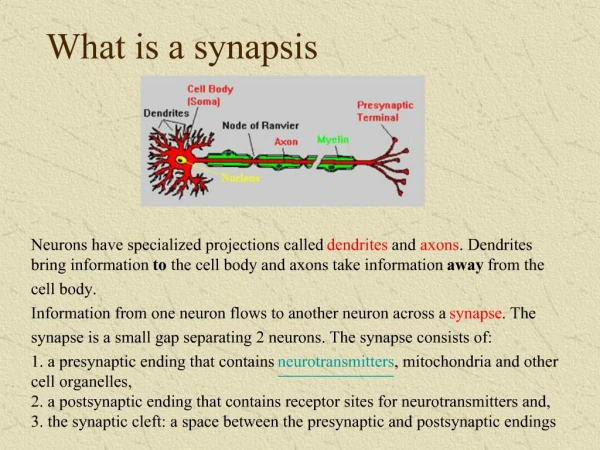
Synapsis is a critical junction between two cells, facilitating the transmission of action potentials. There are two main types: electrical synapses, which allow local currents to flow through gap junctions, and chemical synapses, wherein neurotransmitters are released from presynaptic terminals across a synaptic cleft to bind to postsynaptic membranes. This process can result in excitatory or inhibitory postsynaptic potentials, affecting cell responses. Additionally, neurotransmitter removal and modulation play significant roles in synaptic function, ensuring precise communication between neurons.

What is a synapsis
E N D
Presentation Transcript
1. What is a synapsis
2. The Synapse Junction between two cells
Site where action potentials in one cell cause action potentials in another cell
Types
Presynaptic
Postsynaptic
3. Electrical Synapses Gap junctions that allow local current to flow between adjacent cells
Found in cardiac muscle and many types of smooth
4. Chemical Synapses Components
Presynaptic terminal
Synaptic cleft
Postsynaptic membrane
Neurotransmitters released by action potentials in presynaptic terminal
Synaptic vesicles
Diffusion
Postsynaptic membrane
Neurotransmitter removal
5. More about synapsis
6. Synapsis
7. Neurotransmitters and neuropeptides
8. Postsynaptic Potentials Excitatory postsynaptic potential (EPSP)
Depolarization occurs and response is stimulatory
Depolarization might reach threshold producing an action potential and cell response
Inhibitory postsynaptic potential (IPSP)
Hyperpolarization and response is inhibitory
Decrease action potentials by moving membrane potential farther from threshold
9. Nerotransmitters and Neuromodulators
10. Neurotransmitters etc.
11. Criteria for neurotransmitters
12. Types of neurotransmitters
13. Types of neurotransmitters
14. Transport and release of neurotransmitters
15. Binding and inactivation of neurotransmitters
16. Inactivation of neurotransmitters
17. Neurotransmitter Removal
18. Spatial and Temporal Summation
19. Summation