Download
1 / 53
530 likes | 655 Vues
Explore the diverse world of biomes, focusing on ecosystems' interactions, species, and populations. A biome is defined by its climate, flora, and fauna, including aquatic and land types like tropical forests, tundras, and deserts. Understand the intricate roles of species, their habitats, and communities, along with concepts like competition, cooperation, and symbiosis. Learn about limiting factors, carrying capacity, primary and secondary succession, and the role of pioneer species in ecosystem development. Discover how these elements change and affect life's relationships in nature.

E N D
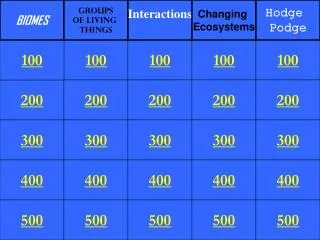
BIOMES Groups Of living Things Interactions Changing Ecosystems Hodge Podge 100 100 100 100 100 200 200 200 200 200 300 300 300 300 300 400 400 400 400 400 500 500 500 500 500
A BIOME is a region of Earth that has a particular climate and certain kinds of plants.
Most Temperate Forests are made up of _________. Coniferous Trees Elmo Trees Deciduous Trees Coconut Trees
1.Temperate Forest2. Tropical Forest3. Tundra4. Desert 5. Grasslands
Which Biome will support the most amount of life? • Explain in detail.
The Tropical Rain Forest will support the most amount of life. It has a warm climate and plenty of rain and fertile soil.
A Species is a group of living things that are closely related that they can breed to make offspring.
A Population is a group of organisms of the same species that live in the same area.
A ______ is the role an animal plays in it’s habitat. Niche Community Species Biome
A community is all of the populations that live and interact with each other in a particular place.
What is a Habitat?Name 2 examples of an animal with their Habitat.
A Habitat is the natural environment in which a living thing gets all it needs to live. Example: Frog lives in or by a pond. A coyote lives in a desert. Answers will vary.
A Predator is an animal that eats other animals. Examples: Shark, Tiger, Lion…
Which of these animals would most likely be a Prey? Omnivore Herbivore Carnivore Great White Shark
Competition is the struggle between individuals or different populations for a limited resource.
Cooperation is an interaction in which organisms work in a way that benefits all.
SYMBIOSIS is the interaction between individuals from 2 different specie that live closely together. 3 Examples: Mutualism Commensalism Parasitism
Any factor that or condition that limits the growth of population in an ecosystem.
What is it called when a population reaches a state where it can NO longer grow? Photosynthesis Limiting Factor Symbiosis Carrying Capacity
What is the name of the first living thing to move into a barren environment?
_________ is the gradual change in an ecosystem in which one biological community is replaced by another . Symbiosis Succession Limiting Factor Biosphere
What is the difference between primary and secondary succession?
Primary Succession occurs when life move to a barren, soil less area. In a Secondary Succession, the ecosystem changes after a disturbance, when there is still soil for life to gain a foothold. .
What is an example of Parasitism? Dog and Tick Termite and Protozoan Biotic and Abiotic Factors Flower and Humming Bird
Which of these is a Pioneer Species? Vulture Sunflower Lichens and Moss Trees