Download
1 / 7
70 likes | 192 Vues
This comparison explores measuring reaction torque vs. in-line torque, with emphasis on alignment, overload protection, and calibration methods. It discusses the impact on dynamic response and the challenges of different measuring principles in various scenarios.

E N D
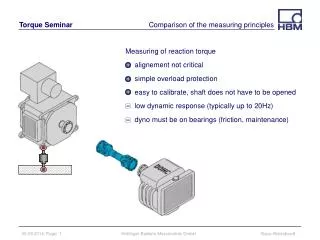
Comparison of the measuring principles • Measuring of reaction torque • alignement not critical • simple overload protection • easy to calibrate, shaft does not have to be opened • low dynamic response (typically up to 20Hz) • dyno must be on bearings (friction, maintenance) 06.09.2014, Page. 1 Hottinger Baldwin Messtechnik GmbH Klaus Weissbrodt
Comparison of the measuring principles • Measuring of in-line torque • measuring of “true torque” in the shaft • high dynamic response (typically up to 1kHz) • dyno is footmounted, no bearings • alignement critical • overload protection difficult • calibration not easy, shaft has to be opened 06.09.2014, Page. 3 Hottinger Baldwin Messtechnik GmbH Klaus Weissbrodt
Comparison of the measuring principles dynamic torque average torque (low pass 20Hz) 5.3 l diesel engine, max. speed 1200 min-1 Shock factor (combustion engines: 2 ... 10) 06.09.2014, Page. 4 Hottinger Baldwin Messtechnik GmbH Klaus Weissbrodt
Comparison of the measuring principles 06.09.2014, Page. 5 Hottinger Baldwin Messtechnik GmbH Klaus Weissbrodt
Comparison of the measuring principles 06.09.2014, Page. 6 Hottinger Baldwin Messtechnik GmbH Klaus Weissbrodt
Comparison of the measuring principles Torque measurement at a transmission • Reaction force at lever arm • In-line torque measurement 06.09.2014, Page. 7 Hottinger Baldwin Messtechnik GmbH Klaus Weissbrodt
13 litre diesel engine startup 6000 4000 2000 0 0 1 2 3 4 5 6 -2000 -4000 -6000 Time (s) Comparison of the measuring principles Effect of a long drive shaft 06.09.2014, Page. 8 Hottinger Baldwin Messtechnik GmbH Klaus Weissbrodt