Early Urbanization
Early Urbanization. The Agricultural Revolution and the Growth of Cities. Remember Push / Pull Factors. Push Factors Bad things that make people migrate away from an area Pull Factors Good things that make people want to migrate to an area. Agricultural Revolution.
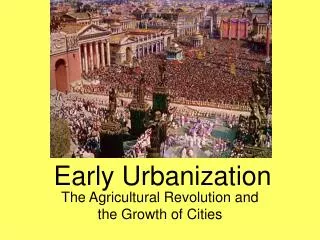

Early Urbanization
E N D
Presentation Transcript
Early Urbanization The Agricultural Revolution and the Growth of Cities
Remember Push / Pull Factors • Push Factors • Bad things that make people migrate away from an area • Pull Factors • Good things that make people want to migrate to an area
Agricultural Revolution • Over 10,000 years ago everybody lived as a hunter-gatherer • All humans were nomads • 1 – 5 million people in the world (8,000 BC) • About 10,000 years ago people discovered agriculture (farming) • Population boomed • 25 – 50 million in world (3,000 – 1,000 BC)
Better Farming Techniques The Plow Irrigation
More Vocabulary Words • Innovation – a new idea or invention • Ex. – the plow • Diffusion – the spreading of innovations around the world • Ex. – agricultural revolution (and the plow) spreading from Egypt to Mesopotamia • Acculturation – change in a culture result of contact with a different culture • Ex. – how does civilizations change after the agricultural revolution?
River Valley Civilizations • People needed more land to farm • Good farmland in river valleys • Access to water for irrigation • People moved to river valleys • Pull Factor – Grow more food in river valleys
Food grows easily in river valleys • Not everybody needs to be a farmer anymore Indus River Valley
SpecializationAcculturating to the Agricultural Revolution • People begin to specialize • Craft workers • Pottery, leather workers, metal workers • Traders • Merchants • Education • Priests, scribes, • Specialized in Non-farming jobs
The First CitiesCause & Effect Agricultural Revolution Migration to River Valleys More People Better Farming Techniques More People More People Specialization Some people don’t need to farm First Cities Bunch of non-farmers
Functions of a CityWhy live in a city? • Water Source • Near rivers • Labor needed for irrigation projects • Defense • City walls to protect from enemies • Trade • Cities built along trade routes • Good places for marketplaces • Religious Centers • Large temples located in cities
Defense - City Walls Walls of Ancient Rome
Structure of Early Cities • Religious Core in the center • Temples or Cathedrals • Government Buildings at core too • Government associated with religion • Surrounding the Religious Core were: • High status business • Associated with religion or government • Secular (non-religious) business • Tailors, jewelers, • Food products and low status business • Leather workers, potters, basket makers • People lived near where they worked • No long commutes
Ancient Cities Layouts High Status Business Secular Business Food and Low Status Business Religious and Government Center The further away from the middle – the less power or status you had
Roman Suburbs Urbs – inside the city walls Latin for city Suburbs – outside the city walls