Mastering the Present Progressive in Spanish: "Estar" + "-ing" Forms
Dive into the intricacies of the present progressive tense in Spanish, which describes actions currently happening. Learn how to use the verb "estar" alongside verbs ending in "-ando" (for -ar verbs) and "-iendo" (for -er/-ir verbs). This guide covers conjugation rules, common orthographic changes, and tricky verbs that require special attention. You'll find examples in both English and Spanish to clarify usage and deepen your understanding, making it easier to construct sentences like "I am studying" and "They are reading."

Mastering the Present Progressive in Spanish: "Estar" + "-ing" Forms
E N D
Presentation Transcript
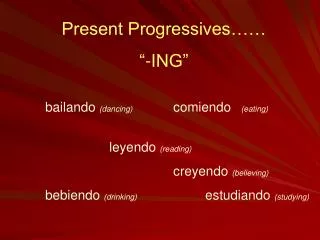
Present Progressives…… “-ING” bailando (dancing) comiendo (eating) leyendo (reading) creyendo (believing) bebiendo (drinking) estudiando (studying)
The present progressive talks about what is happening right now. For example: You are eating. He is reading. I am studying. To form this in Spanish, use a conjugated form of ESTAR (to be) followed by the –ing. Soooo…. ¿Cuáles son las formas de estar? present progressive…-ING
ESTAR (to be) ….. Notice the accents!! yo tú él,ella, Ud. nosotros vosotros ellos, ellas, Uds. estoy (I am) estás (You are) está (He/She is) estamos (We are) estáis (Y’all are) están (They are) <<<<<< <<<<<< <<<<<< <<<<<< present progressive…-ING
Next…. Replace the –AR ending of –ar verbs with –ANDO and the –ER/-IR endings of –er/-ir verbs with -IENDO bail AR ANDO dance dancING com IENDO ER eat eatING escrib IR IENDO write writING present progressive…-ING
A couple little tricky things…. Sometimes you must change the spelling in order to maintain the original sound of the word. This is called an orthographic change. Some common examples are: caer: cayendocreer: creyendohuir: huyendoir: yendoinfluir: influyendooír: oyendotraer: trayendoleer: leyendoseguir: siguiendo One way to remember which to change is to conjugate the verb “normally” and if you end up with three (3) vowels in a row, then you need to replace the “i” with “y”. present progressive…-ING
For example… 3 vowels (aei)!!! Drop the “i” & add a “y” caer (to fall) leer(to read) traer (to take) ca Yendo IENDO 3 vowels (eie)!!! Drop the “i” & add a “y” le IENDO Yendo 3 vowels (aei)!!! Drop the “i” & add a “y” tra IENDO Yendo Why??? Say the first version (with the 3 vowels) and then say the word with the replacement “y” in there. Which one is easier to say?? caIENDO or caYendo present progressive…-ING
One more little tricky thing…. To form the present participle of -ir stem changing verbs (BOOT VERBS!) change e->i and o->u in the stem, and then add -iendo to the stem of the verb. e->i servir (to serve)pedir (to ask for) decir (to say) servir sirviendo sirvir pidiendo pedir ->>> diciendo decir ->>> o->u dormir (to sleep)morir (to die) dormir durmir durmiendo morir ->>> muriendo present progressive…-ING
Put it all together…. Estar + present particple (-ing) • Traduzca lo siguiente. • I am studying (estudiar). ___________________ • They are reading (leer). ___________________ • Y’all are bringing (traer). ___________________ • He is dying (morir). ___________________ • We are serving. (servir). ___________________ • You (tú) are eating (comer). ___________________ (Yo) estoy estudiando. (Ellos/as) están leyendo. (Vosotros) estáis trayendo. (Él) está muriendo. (Nosotros) estamos sirviendo. (Tú) estás comiendo. present progressive…-ING