

SlideServe
Menu
Préférences
© SlideServe · v2026

Signal Transduction

erma avatar
61 diapositives · 2K Views · Oct 15, 2014

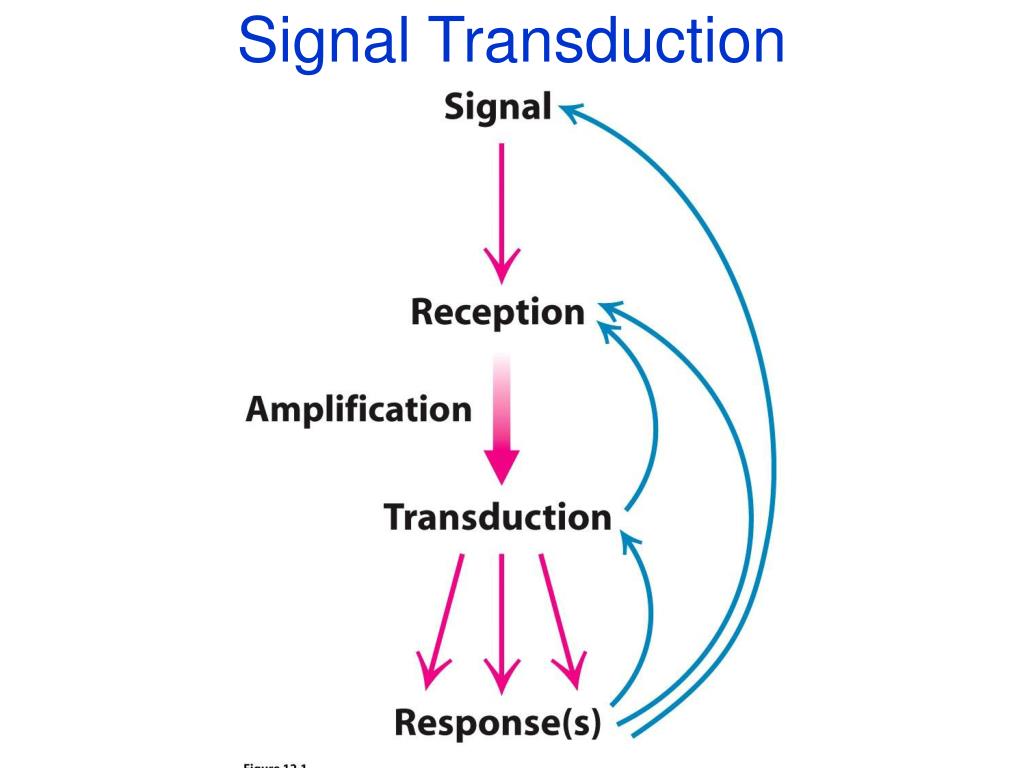
Signal Transduction. Signal Transduction. Signal outside cell is recognized Transmission across membrane Effect inside cell. Signal Transduction & Molecular Circuits. A primary messenger (hormone-H) binds to the extracellular part of a membrane-embedded receptor (R)
Signal Transduction - slide 1
01 / 61Signal Transduction
1 / 17

Télécharger la présentation

Signal Transduction
Une image / un lien ci-dessous est fourni (tel quel) pour télécharger la présentation

Politique de téléchargement : le contenu du site vous est fourni TEL QUEL pour votre information et votre usage personnel ; il ne peut être vendu, concédé sous licence ni partagé sur d’autres sites sans l’accord de son auteur.Le contenu vous est fourni TEL QUEL, pour votre information et votre usage personnel uniquement. Téléchargez la présentation en cliquant sur ce lien. Lors du téléchargement, si vous ne parvenez pas à télécharger une présentation, l’éditeur a peut-être supprimé le fichier de son serveur.Pendant le téléchargement, si vous ne parvenez pas à obtenir une présentation, le fichier a peut-être été supprimé par l’éditeur.

F I N

Plus de contenu associé

Transcription de la présentation
  1. Signal Transduction

  2. Signal Transduction • Signal outside cell is recognized • Transmission across membrane • Effect inside cell

  3. Signal Transduction & Molecular Circuits A primary messenger (hormone-H) binds to the extracellular part of a membrane-embedded receptor (R) The HR complex generates a second messenger inside the cell which activates proteins that alter the biochemical circuitry inside the cell Then, mechanisms are activated to terminate the signal transduction pathway

  4. Signal Transduction Molecular Switches • Membrane embedded receptor Proteins transmit information into the cell • The Ras protein, like the Ga subunit of heterotrimeric G proteins, cycles between an inactive GDP-bound form and active form bound to GTP • Tyrosine kinase modules of some receptors upon dimerization are activated by cross-phosphorylation. Phosphorylated tyrosines serve as docking sites for adaptor and signaling proteins which permit further propagation of the signal. • Net result is amplification, fidelity and diversity

  5. Signal Transduction

  6. What G-proteins can Do

  7. Common Second Messengers

  8. Adrenaline

  9. G-proteins-also known as GPCRsfor G-protein coupled receptors • Trimeric molecular amplifiers (,, subunits,  and  are lipid-linked thus membrane bound) • Bind to 7-transmembrane receptors on the cytosolic side • Receptor activationswitch GTP for GDP  disassociation of  from 

  10. G-protein activation of adenylate cyclase

  11. A heterotrimeric G-protein

  12. The Basic Structure (Ras)

  13. The Basic Structure (G-protein)

  14. Switching States • 3 main areas of G-protein change conformation: • Switch I: Moves closer to Guanine when active, Thr177 H-bonds to the -phosphate of GTP • Switch II: a-helix 2 rotates so G199 can H-bond to -phosphate, which pulls b-strand 3 away from b-strand 1 and toward b-strand 2. This breaks old hydrogen bonds and makes new ones. • Switch III: interacts with switch II which propagates its structural changes to it.

  15. Switch I

  16. Switch II

  17. Switch III

  18. Mechanism of Hydrolysis • General idea: • generate OH- to attack -phosphate • Have to neutralize the negative charge on the phosphate

  19. Model

  20. The odd case of Ras • Ras lacks the Arg that stabilizes the negative charge on the phosphate! • Ras is very very slow at hydrolyzing GTP—is this why? • Ras GTPase activating protein (GAP) supplies the necessary Arg residue and speeds up the reaction nearly 100,000 fold

  21. Why is all this important? • Ras is a signalling molecule activated by various receptors in different pathways, including cell growth signals. • Ras is mutated in 25% of human tumors • Mutations inactivate the GTP hydrolysis step, thereby keeping Ras switched “on”—and thus Ras keeps on stimulating cells to divide.

  22. What G-proteins can Do Source: Molecular Biology of the Cell, fourth ed. 2002

  23. The G-protein Cycle • GTP form = active • GDP form = inactive • activated -subunit hydrolyzes GTP to GDP • special proteins help GTP hydrolysis (Regulators of G-protein Signaling, RGS) •  and  subunits re-assemble into inactive form

  24. Cholera Toxin (CT) • CT is an AB toxin. • B is a pore that allows toxin entry into cells • A is an enzyme that stabilizes the active GTP-bound form of Ga • Active Ga activates Protein Kinase A (PKA) • PKA activates by phosphorylation a Cl- channel and a Na+ - H + exchanger • The net consequence is massive loss of NaCl and water from the intestine

  25. Why use G-proteins? • Amplification at two steps: • Active receptor can activate multiple G-proteins (by causing GTP to replace GDP) • Each downstream target (eg adenylate cyclase) can produce many second messengers (eg, cyclic AMP) • Cells can regulate how long the switch is turned on • Different RGS molecules in different cells or at different times

  26. How Does it Work? • Why does GTP binding cause disassociation of  from the  subunits? • How does hydrolysis of GTP occur to re-set the system?

  27. The structure of the G subunit • Contains 7 repeats of ~40aa: WD repeats

  28. The GTPase domain of G binds to G in the inactive form

  29. Phosducin regulates light adaptation in retinal rods • In rod cells: • Rhodopsin absorbs photons • Activates G-protein called transducin • Transducin activates cGMP phosphodiesterase degradation of cGMP • One photondegradation of over 100,000 cGMP molecules!! • To dampen the sensitivity, phosducin reduces transducin’s activity • Binds G and pulls it into the cytoplasm where it is inactive

  30. Structure of phodsucin

  31. G phosducin Phosducin blocks G binding site of G Phosducin binding is negatively regulated by phosphorylation of Serine 73

  32. How Ras gets activated

  33. Signal Transduction Molecular Switches • Membrane embedded receptor Proteins transmit information into the cell • The Ras protein, like the Ga subunit of heterotrimeric G proteins, cycles between an inactive GDP-bound form and active form bound to GTP • Tyrosine kinase modules of some receptors upon dimerization are activated by cross-phosphorylation. Phosphorylated tyrosines serve as docking sites for adaptor and signaling proteins which permit further propagation of the signal. • Net result is amplification, fidelity and diversity

  34. G-protein and receptor tyrosine kinase signalling pathways

  35. Growth Hormone