Anatomy
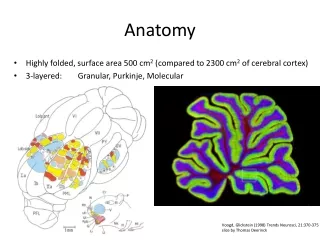
The cerebellar cortex, with its highly folded surface area, is organized into three layers: granular, Purkinje, and molecular. Granule cells, numbering around 50 billion, form parallel fibers in the molecular layer. Purkinje cells serve as the sole output, projecting to cerebellar and vestibular nuclei, and exhibit complex dendritic arbors with numerous synapses. The intricate connections between Purkinje and climbing fibers highlight the dynamic nature of cerebellar signaling, crucial for motor coordination and learning. Recent studies have enhanced our understanding of these cells' neurophysiological properties.

Anatomy
E N D
Presentation Transcript
Anatomy • Highly folded, surface area 500 cm2 (compared to 2300 cm2 of cerebral cortex) • 3-layered: Granular, Purkinje, Molecular Voogd, Glickstein (1998) Trends Neurosci, 21:370-375slice by Thomas Deerinck
Cerebellar Cortex • Granule cells – most numerous in CNS, ~50 billion • Axons form parallel fibers in molecular layer, up to 3 mm • Purkinje cells sole output – inhibitory • Interneurons: Golgi, stellate, basket • PC target – vestibular and deep nuclei Rokni et al (2008) Front Neurosci, 2:192-198
Median cell counts in vertebrate cerebellar structures From data summarized in KWT Caddy and TJ Biscoe (1979) Phil Trans Roy Soc Lond Ser B 287:167-201. Additional measurements from BB Gould and P Rakic (1981) Exp Brain Res 44:195-206, R Alvarez and R Anadón (1987) J Hirnforsch 28:133-137, RJ Harvey and RMA Napper(1991) Prog Neurobiol 36:437-463, JA Heckroth (1994) J Comp Neurol 343:173-182, and R Alvarez-Otero et al (1996) J Comp Neurol 368:487-502. JC Eccles (1969) Naturwissenschaften 56:525-534
Cerebellar Output • All Purkinje cells project to one of the cerebellar nuclei (dentate, interpositus, fastigial) or one of the vestibular nuclei
Purkinje cells • Dendritic arbors, ~180,000 PF synapses in humans - however, at any given time up to 80% of these synapses are ‘silent’- planar dendritic arbor- fast AMPA EPSCs, and slow mGluR1- also receives 20-30 inhibitory stellate/basket cells • GABAergic projection neuron • Spontaneous pacemaking, 20-100 Hz - depends on a ‘resurgent’ sodium current Raman, Bean (1999) J Neurosci 19:1663-1674
Climbing fibers and complex spikes • Strong multisynaptic connection- ~25,000 synapses- strongest afferent in CNS- glutamatergic • Purkinje cell complex spikes - very large EPSP with Calcium spikes • Complex results in a pause of ongoing simple spike firing Kreitzer et al. (2000) Neuron, 27:25-32 Davie et al. (2008) J Neurosci, 28:7599-7609