
Understanding Protein Synthesis: From DNA to Polypeptides
E N D
Presentation Transcript
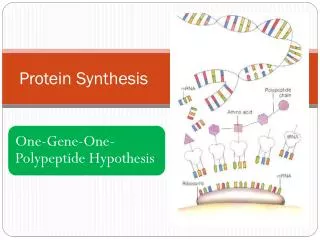
The DNA Code • The order of bases along the DNA strand codes for the order in which amino acids are chemically joined together to form a polypeptide
Protein synthesis involves two types of nucleic acids: DNA (deoxyribonucleic acid) RNA (ribonucleic acid)
RNA • RNA, like DNA, is a polymer formed by a sequence of nucleotides • Three Types of RNA: messenger RNA (mRNA) transfer RNA (tRNA) ribosomal RNA (rRNA)
Differences Between DNA and RNA DNARNA double-stranded single-stranded sugar = deoxyribose sugar = ribose bases = A,T,C,G bases = A,U,C,G (uracil takes the place of thymine)
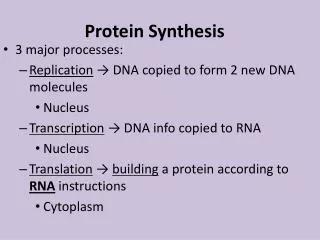
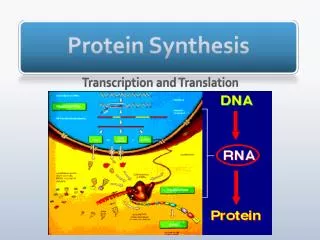
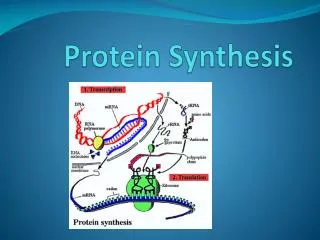
Protein Synthesis involves two processes: • Transcription: the copying of the genetic message (DNA) into a molecule of mRNA • Translation: mRNA is used to assemble an amino acid sequence into a polypeptide
Transcription • occurs in the nucleus of the cell 1) DNA strand separates and serves as a template (pattern) for mRNA assembly
2) free mRNA nucleotides match up to the exposed nucleotides on the DNA strand
http://www.johnkyrk.com/DNAtranscription.html • mRNA strand leaves the DNA strand when a “stop codon” is reached • the mRNA strand carries the code for the production of one polypeptide
A sequence of 3 bases called a codon codes for one amino acid
Translation • occurs in the cytoplasm of the cell, at the ribosome • 1) mRNA moves out of the nucleus and into the cytoplasm to a ribosome
2) mRNA is “read” by the ribosome and is converted to a chain of amino acids with the help of tRNA
As the mRNA moves across the ribosome, tRNAs temporarily attach. The amino acids are joined by a chemical bond by enzymes until a stop codon is reached • a polypeptide is produced
Animations • http://www.lewport.wnyric.org/JWANAMAKER/animations/Protein%20Synthesis%20-%20long.html • http://www.ncc.gmu.edu/dna/ANIMPROT.htm