Download
1 / 23
240 likes | 347 Vues
This study analyzes wind time series data to compare complexities and entropies between event and stationary periods. Using normalized permutation entropies and Jensen-Shannon complexities, results reveal no definitive trends without filtering. An embedding delay of 10 improves separation between signals; however, differences in complexity and entropy remain subtle. Analysis is conducted on 5000-value portions of the CME time series, providing insights into stochastic behavior across various spatial directions.

E N D
No delay cont. WIND data- Normalized Permutation Entropies WIND data- Jensen-Shannon Complexities
Delay 10 cont. WIND data- Normalized Permutation Entropies WIND data- Jensen-Shannon Complexities
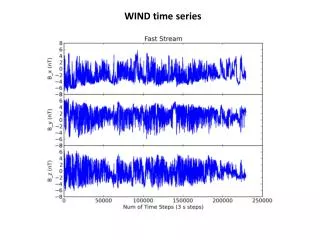
The next 5 slides show the results of analysis run on 5000-value portions of the CME time series corresponding to an event and a more stationary period. • Without any filtering, there is no definitive trend across spatial directions marking one portion as more stochastic (lower C, higher PE) than the other. • When an embedding delay of 10 is used, the stationary and event signals to separate as expected for all spatial directions, with the event slightly more complex and less entropic. Still, the difference is quite small.
Unfiltered Delay 10
CH plane with positions of 10 sections of B_x fast stream time series Standard Deviation in PE = 0.006 Standard Deviation in C = 0.007