Evolution
This resource explores the foundations of evolution, delving into its various theories and mechanisms such as natural selection, speciation, and the evidence supporting these concepts. We examine historical figures like Lamarck, Cuvier, and Lyell, alongside insights into gradualism, catastrophism, and Darwin's "descent with modification." Additionally, we discuss the phenomenon of antibiotic and pesticide resistance, illustrating how these contemporary issues exemplify evolutionary principles in action. Engage with the complexity of life and the ongoing processes of adaptation and change.

Evolution
E N D
Presentation Transcript
3/27/12 • Objective: Introduce origins theories • Do Now: Hand in popular science questions • Do Later: Read sections 13.1-3
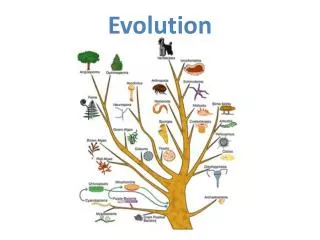
Diversity of life • Estimated 10 million species on earth • Phylogenetic trees show relationships
Origins Theories • Lamarck • Spontaneous generation • Simple organisms are more recent • Complex organisms are older, gained complexity over time • Theory of Acquired Characteristics • Characteristics acquired by parents get passed on to offspring
Origins Theories • Catastrophism • Rapid, catastrophic events shape geology and extinction • Gradualism • Slow change of geologic features and life forms over time Georges Cuvier Charles Lyell
Origins Theories • “Descent with modification” • Species have natural variation • Certain characteristics are favored over time
Natural Selection • Condition 1: Variation • Populations must have variation in traits for selection to occur
Natural Selection • Condition 2: Competition • “Survival of the fittest” • Scarce resources, avoiding predators, etc. • Only the best adapted species survive
Natural Selection • Condition 3: Inheritance • Favorable traits are passed on to offspring • Genetic inheritance
Natural Selection • Theory of Natural Selection • Heritable traits that confer an advantage in survival and reproduction will increase in frequency in a population. • Gradually a population will change as a result of natural selection.
Artificial Selection • Selection performed by a conscious agent. • Dog breeding • Crop selection
4/2/12 • Objective: To examine speciation and evidence for natural selection • Do now: • Discuss with a partner – What is a species? • Come up with a definition in pairs • Do later: Read 13.5-6 in text • On separate paper: Pg. 275 #1, 3-7, 12
Species • A species is a group of organisms that are able to interbreed and produce fertile offspring. Mules are the offspring of a male donkey and a female horse. They are sterile.
Hybrid Species Zebra + horse zebroid (sterile) Tiglons can occasionally reproduce with difficulty.
Speciation • How do new species come to be (speciation)? • 1) Population is separated • 2) Each population changes due to natural selection • 3) Differences accumulate to make interbreeding impossible
Evidence for Natural Selection • Biogeography • Geographic distribution of species Why do all marsupials live in Australia?
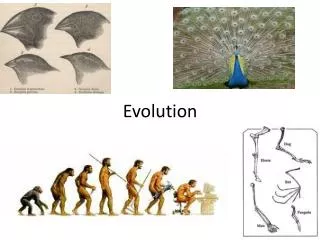
Evidence for Natural Selection • Homologous Structures • Anatomically similar structures in groups of related organisms • May serve different functions
Evidence for Natural Selection • Molecular Biology • DNA sequencing can confirm the relationship between two species • Few genetic differences = closely related • Many genetic differences = distantly related 98.5% similar
4/3/12 • Objective: • Do Now: • Pick two evidences for evolution and explain (in writing) how they show “descent with modification”. (3 minutes) • Do Later:
Evidence for Natural Selection • Vestigial Structures • Structure that is no longer used in an organism • Artifact of a useful structure in an ancestor
Vestigial Structures • Whale pelvis
Vestigial Structures • Human Coccyx
Vestigial Genes • Vestigial genes – organisms have genes in their DNA that are no longer active • Chicken teeth • Genes for teeth can be turned back on in chickens
Transitional forms • Fossil evidence of an intermediate form between a present day species and an ancestor.
Transitional Forms • Archaeopteryx – transitional form between dinosaurs and modern birds Archaeopteryx – between dinosaurs and aves (birds)
Transitional forms • Tiktaalik • Transitional form between aquatic and land animals • “lobe finned fish”
Transitional Forms Basilosaurus – intermediate between land mammals and whales whale
Comparative Embryology • Early stages of development are similar across the animal kingdom
4/6 • Objective: To discuss pesticide and antibiotic resistance • Do later: Popular Science – Pesticide and antibiotic resistance
Pesticide Resistance • Application of pesticides selects for pesticide resistance Red = pesticide resistant White = wild type (‘normal’)
Pesticide Resistance • Colorado Potato Beetle • Agricultural pest • Resistant to all major classes of insecticides
Pesticide Resistance • Can you think of any ways to combat pesticide resistance? • Pesticide rotation • Natural predators • Diversifying crops The fungus Beauveriabassianais toxic to many beetles but non-toxic to humans Diversifying crops can limit the spread of pests
Antibiotic Resistance • Use of antibiotics selects for antibiotic resistant bacteria. • Drug resistance evolves over time.
Antibiotic Resistance • Methicillin-Resistant Staph Aureus (MRSA) • “Staph infection” • Resistant to many classes of anti-staphylococcus drugs
Antibiotic Resistance • Extensively Drug Resistant Tuberculosis (XDR-TB) • Lung disease • Resistant to three or more major anti-TB drug classes • High mortality (50% +)
Antibiotic Resistance • Solutions? • Limit prescription of antibiotics • Limit use of antibiotics in agriculture • Use full prescriptions • Vary prescriptions
4/17/12 • Objective: To examine varieties of selection • Do Now: • With a partner, describe the differences between natural selection, artificial selection, and sexual selection. Provide an example of each. • Do later: • Read 13.13 and 13.17 in text
Stabilizing Selection • Selection that favors intermediate phenotypes Stabilizing selection regulates birth weight
Directional Selection • Selection that favors extreme phenotypes in one direction Peppered moths
Disruptive Selection • Selection that favors extreme phenotypes in both directions Galapagos iguanas
Practice time! • With a partner, come up with an example of stabilizing and directional selection. • Challenge: Can you think of an example of disruptive selection?
Popular Misconceptions • Natural Selection does not createany traits. • It only selects on existing traits. Where do new traits come from?
Popular Misconceptions • Natural Selection is not goal oriented • Simpler organisms are older, but not less fit.
Popular Misconceptions • Natural Selection is subject to constraints • Advantageous traits often come with trade-offs
4/20/12 • Objective: To learn about hypotheses for the origin of cells • Do Now: In your notes, make a T chart to compare the conditions of early and modern Earth • Do Later: Read Ch. 15.1-3 in text
Evidence for Early Life • Stromatolites – 3.5 billion years old • Oldest fossils • Single celled organisms • Grow in mats that harden into rock
Cell Theory • Cell theory • All living things are composed of cells and their products • New cells arise from the division of older cells • Cells are the basic building blocks of life • Where did the first cells come from?
Miller’s Experiment • Stanley Miller (1953) • Hydrogen gas (H2) • Ammonia (NH3) • Methane (CH4) • Water vapor • Spark • Product? Amino acids.