Download
1 / 6
60 likes | 294 Vues
This text provides a comprehensive overview of weak acids and bases, focusing on their ionization in water and the significance of the ionization constant (Ka). It explains how to calculate Ka from pH, determine percent ionization, and find pH from Ka values. Through examples like hydrofluoric acid (HF) and formic acid (HCHO2), it demonstrates the calculation of equilibrium concentrations and emphasizes that with weak acids, only a small fraction ionizes, leading to unique properties of these substances.

E N D
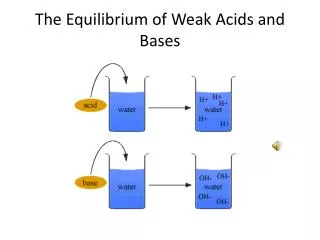
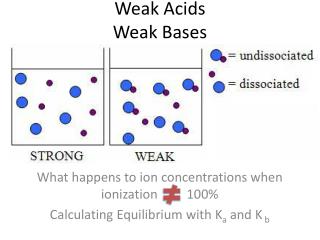
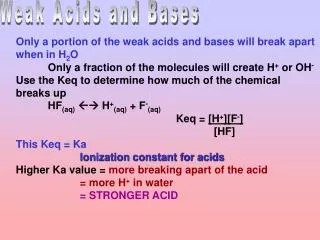
Weak Acids and Bases Only a portion of the weak acids and bases will break apart when in H2O Only a fraction of the molecules will create H+ or OH- Use the Keq to determine how much of the chemical breaks up HF(aq) H+(aq) + F-(aq) Keq = [H+][F-] [HF] This Keq = Ka Ionization constant for acids Higher Ka value = more breaking apart of the acid = more H+ in water = STRONGER ACID
2. Calculating Ka from pH If we know the pH, we can get the Ka 1. Use the equilibrium chart 2. Use pH to determine [H+] at equilibrium 3. Determine other concentrations at equilibrium 4. Use Ka expression to calculate Ka Example If the pH of a 0.1 M HX is 4.75, what is Ka? HX H+ + X- 0.1 M 0.0 M 0.0 M -x X X 0.1 - 1.778 x 10⁻⁵ 1.778 x 10⁻⁵ 1.778 x 10⁻⁵ 1 x 10-4.75 The subtracted amount is so small, we can ignore it!!
Ka = [H+][X-] [HX] 3. Determining the Percent ionized acid If we need to know what percent of the acid is ionized % = . [H+] . original concentration Percent ionized = 1.778 x 10-5 x 100 0.1 Ka = (1.778 x 10⁻⁵)2 0.1 Ka = 3.16 x 10⁻⁹ 0.0178%
Example – Calculate the Ka of a 0.50 M solution of formic acid (HCHO2) with a pH of 2.02. Also determine the percent ionization in the acid. HCHO2 H+ + CHO2- 0.5 M 0.0 M 0.0 M -x X X 0.5 – 9.55 x 10⁻³ 9.55 x 10⁻³ 1 x 10-2.02 9.55 x 10⁻³ Again, the subtracted amount is so small, we can ignore it!! Ka = [H+][CHO2] [HCHO2] Ka = (9.55 x 10⁻³)2 0.5 Ka = 1.8 x 10⁻⁴ Percent ionized = [H+] original [HCHO2] 9.55 x 10⁻² 0.5 1.91%
4. Finding pH from Ka Done much the same way 1. Set up the chart 2. Determine final concentration in terms of x 3. Us Ka to solve for x and final [ ] of all products 4. Take the –log of the final [H+] Example – If HY has a Ka of 5.3 x 10⁻⁵, what is the pH of a 0.1 M solution? HY H+ Y- 0.1 M 0.0 M 0.0 M -x X X x 0.1 - x x But, in previous problems, 0.1 – x is essentially 0.1 If ionization is less than 5%, we can ignore the amount of ionized acid from the original amount
When we finish the problem, we should check to make sure that the ionization is less than 5%. Ka = X2 0.1 5.3 x 10-5 = X2 0.1 X = 2.30 x 10⁻³ This means that [H+] is 2.30 x 10⁻³ M pH = -log (2.3 x 10⁻³) pH = 2.64 Now check to make sure ionization is less than 5% % ionized = [H+] x 100 [HY] 2.30 x 10-3x 100 0.1 2.30 % We’re safe!