
SlideServe
Menu
Préférences
© SlideServe · v2026

Chapter 15 Oscillations In this chapter we will cover the following topics:

fjanicki avatar
13 diapositives · 172 Views · Jan 04, 2020

Chapter 15 Oscillations In this chapter we will cover the following topics: Displacement, velocity, and acceleration of a simple harmonic oscillator Energy of a simple harmonic oscillator
Chapter 15 Oscillations In this chapter we will cover the following topics: - slide 1
01 / 13Chapter 15 Oscillations In this chapter we will cover the following topics:
1 / 17

Télécharger la présentation

Chapter 15 Oscillations In this chapter we will cover the following topics:
Une image / un lien ci-dessous est fourni (tel quel) pour télécharger la présentation

Politique de téléchargement : le contenu du site vous est fourni TEL QUEL pour votre information et votre usage personnel ; il ne peut être vendu, concédé sous licence ni partagé sur d’autres sites sans l’accord de son auteur.Le contenu vous est fourni TEL QUEL, pour votre information et votre usage personnel uniquement. Téléchargez la présentation en cliquant sur ce lien. Lors du téléchargement, si vous ne parvenez pas à télécharger une présentation, l’éditeur a peut-être supprimé le fichier de son serveur.Pendant le téléchargement, si vous ne parvenez pas à obtenir une présentation, le fichier a peut-être été supprimé par l’éditeur.

F I N

Plus de contenu associé

Transcription de la présentation
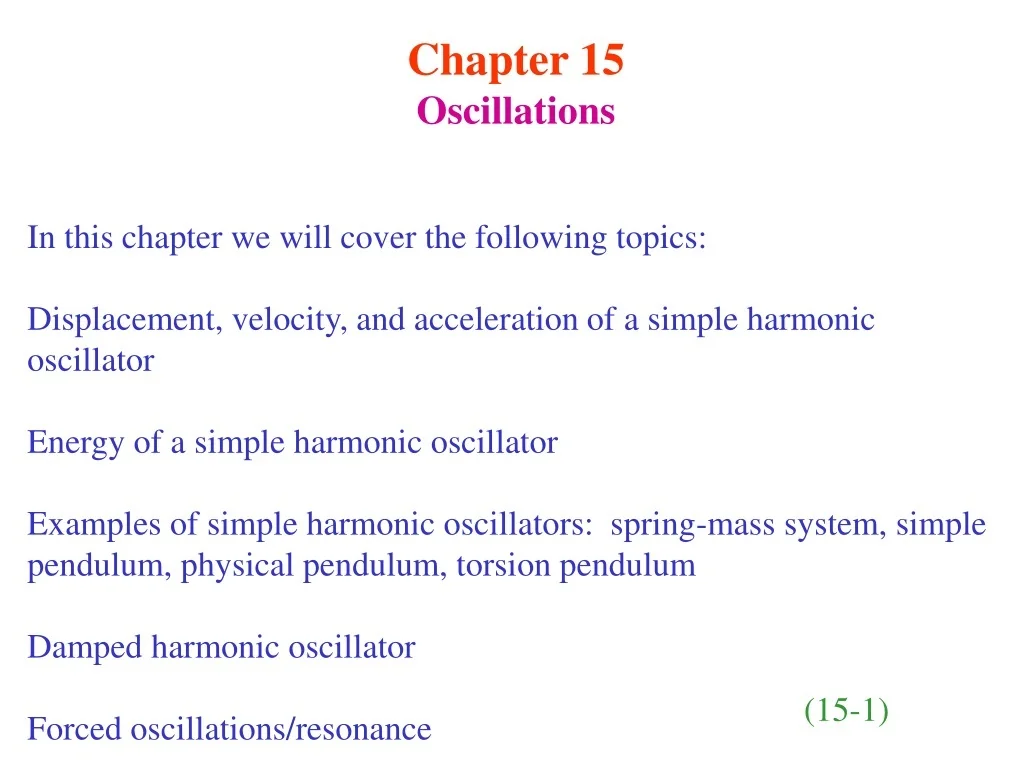
  1. Chapter 15 Oscillations In this chapter we will cover the following topics: Displacement, velocity, and acceleration of a simple harmonic oscillator Energy of a simple harmonic oscillator Examples of simple harmonic oscillators: spring-mass system, simple pendulum, physical pendulum, torsion pendulum Damped harmonic oscillator Forced oscillations/resonance (15-1)

  2. (15-2)

  3. (15-3)

  4. (15-4)

  5. (15-5)

  6. (15-6)

  7. (15-7)

  8. In the small-angle approximation we assumed that  << 1 and used the approximation sin  . We are now going to decide what is a “small” angle, i.e., up to what angle  is the approximation reasonably accurate?  (degrees) (radians) sin  5 0.087 0.087 10 0.174 0.174 15 0.262 0.259 (1% off) 20 0.349 0.342 (2% off) Conclusion: If we keep  < 10 ° we make less than 1 % error. (15-8)

  9. (15-9)

  10. (15-10)

  11. (15-11)

  12. (15-12)

  13. Moving support (15-13)