Download
1 / 1
10 likes | 126 Vues
Understanding the distribution of inorganic chlorine (Cly) in the stratosphere is crucial for attributing stratospheric ozone changes to halogen shifts and evaluating chemistry-climate models. Direct observations of Cly are sparse, but HCl measurements in the upper stratosphere can be used for inference. We present a framework to correct inter-instrument biases in HCl data, enhanced by neural network techniques. This allows us to merge Cly observation periods with long-term HCl records, producing a reliable long-term Cly dataset with quantified uncertainties.

E N D
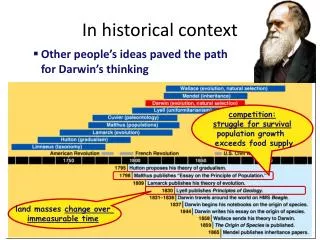
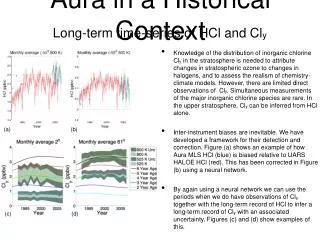
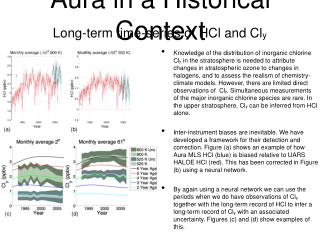
(a) (b) (c) (d) Aura in a Historical Context Long-term time-series of HCl and Cly • Knowledge of the distribution of inorganic chlorine Cly in the stratosphere is needed to attribute changes in stratospheric ozone to changes in halogens, and to assess the realism of chemistry-climate models. However, there are limited direct observations of Cly. Simultaneous measurements of the major inorganic chlorine species are rare. In the upper stratosphere, Cly can be inferred from HCl alone. • Inter-instrument biases are inevitable. We have developed a framework for their detection and correction. Figure (a) shows an example of how Aura MLS HCl (blue) is biased relative to UARS HALOE HCl (red). This has been corrected in Figure (b) using a neural network. • By again using a neural network we can use the periods when we do have observations of Cly together with the long-term record of HCl to infer a long-term record of Cly with an associated uncertainty. Figures (c) and (d) show examples of this.