Download
1 / 11
110 likes | 235 Vues
Ocean acidification, exacerbated by rising CO2 emissions, poses a significant threat to marine ecosystems. Increased acidity stresses various marine organisms, impacting their growth, reproduction, and overall metabolic functions. This phenomenon risks altering food webs and diminishing biodiversity, creating potential cascading effects on valuable fisheries and coastal economies. Mitigation of these challenges requires a reduction in CO2 emissions. Understanding the implications for marine life is crucial as we strive to maintain ecological balance and the sustainability of ocean resources.

E N D
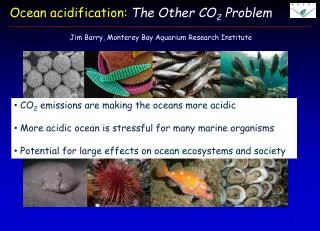
Ocean acidification: The Other CO2 Problem Jim Barry, Monterey Bay Aquarium Research Institute • CO2 emissions are making the oceans more acidic • More acidic ocean is stressful for many marine organisms • Potential for large effects on ocean ecosystems and society
What is Ocean Acidification? Carbon Dioxide Low Carbonate = Problems for shell-makers Carbonic acid CO2 bicarbonate protons carbonate + H20 H2CO3 HCO3-+ H+ CO3-2+ H+ Abundance in Seawater Acidity Marine Shells = CaCO3
Fossil Fuel Carbon Dioxide in the Ocean Sabine et al. (2004) South North • Fossil fuel CO2 to >1000+ meters • >500 billion tons of CO2 emissions in the ocean • Ocean CO2 ‘disposal’ is now ~3 million tons per hour
Physiological Effects on Organisms • Shell and skeleton formation • Respiratory Stress • Enzyme Function • Metabolic Depression
What are the options for organisms faced with ocean acidification? • Acclimation • Adaptation • Extinction Hmmm..?
Effects on individuals can affect ecosystems Stressed Normal More energy for: = Less energy for: Cost of Living Growth Growth Cost of Living Reproduction Energy Budget Reproduction
Present Ocean Food Web – Diverse, Complex, Productive Primary Producers What are the expected effects of ocean acidification on ocean ecosystems? Zooplankton food web Upper Trophic levels Sinking Organic Debris Microbial Remineralization Seafloor community
Future Ocean Food Web– Loss of biodiversity, low productivity, dominated by microbial recycling? Primary Producers • Reduced Biodiversity • Simplified Food Web • Ecological Tipping Point? Upper Trophic levels Zooplankton food web Sinking Organic Debris Microbial Remineralization Seafloor community
What about California? • Ecosystems with lower biodiversity: • Lower productivity • Lower stability • Lower resilience Commercial Fisheries: $120 Million Squid Loss of ecological stability Crab Urchin Cascading economic consequences • Potential effects of acidification / warming on our fisheries: • Reduced biodiversity, • Increased variation in fishery catch • More frequent fishery collapses • Reduced potential for recovery
The bottom line • What we know: • Ocean acidification is ongoing, massive, increasing • Causes physiological stress for many species • Can only be mitigated by reduced CO2 emissions • What we expect: • Food webs will be affected • Ecosystem services (e.g. fisheries) will change • What we don’t know: • Capacity for acclimation and adaptation • Effects on marine communities, ecosystems - tipping points? • What will this mean for California & coastal states? • Productivity and Stability of Fisheries Multiple Stressors Synergistic effects of warming, acidification, reduced oxygen levels may further impact ocean ecosystems