
SlideServe
Menu
Préférences
© SlideServe · v2026

Understanding Power and Work in Physics

floyd avatar
3 diapositives · 145 Views · Jul 28, 2014

Explore the concepts of power and work in physics, including their definitions, relationship, and calculation methods. Learn how power is the rate at which work is done and how to determine power in various scenarios.
Understanding Power and Work in Physics - slide 1
01 / 3Understanding Power and Work in Physics
1 / 17

Télécharger la présentation

Understanding Power and Work in Physics
Une image / un lien ci-dessous est fourni (tel quel) pour télécharger la présentation

Politique de téléchargement : le contenu du site vous est fourni TEL QUEL pour votre information et votre usage personnel ; il ne peut être vendu, concédé sous licence ni partagé sur d’autres sites sans l’accord de son auteur.Le contenu vous est fourni TEL QUEL, pour votre information et votre usage personnel uniquement. Téléchargez la présentation en cliquant sur ce lien. Lors du téléchargement, si vous ne parvenez pas à télécharger une présentation, l’éditeur a peut-être supprimé le fichier de son serveur.Pendant le téléchargement, si vous ne parvenez pas à obtenir une présentation, le fichier a peut-être été supprimé par l’éditeur.

F I N

Plus de contenu associé

Transcription de la présentation
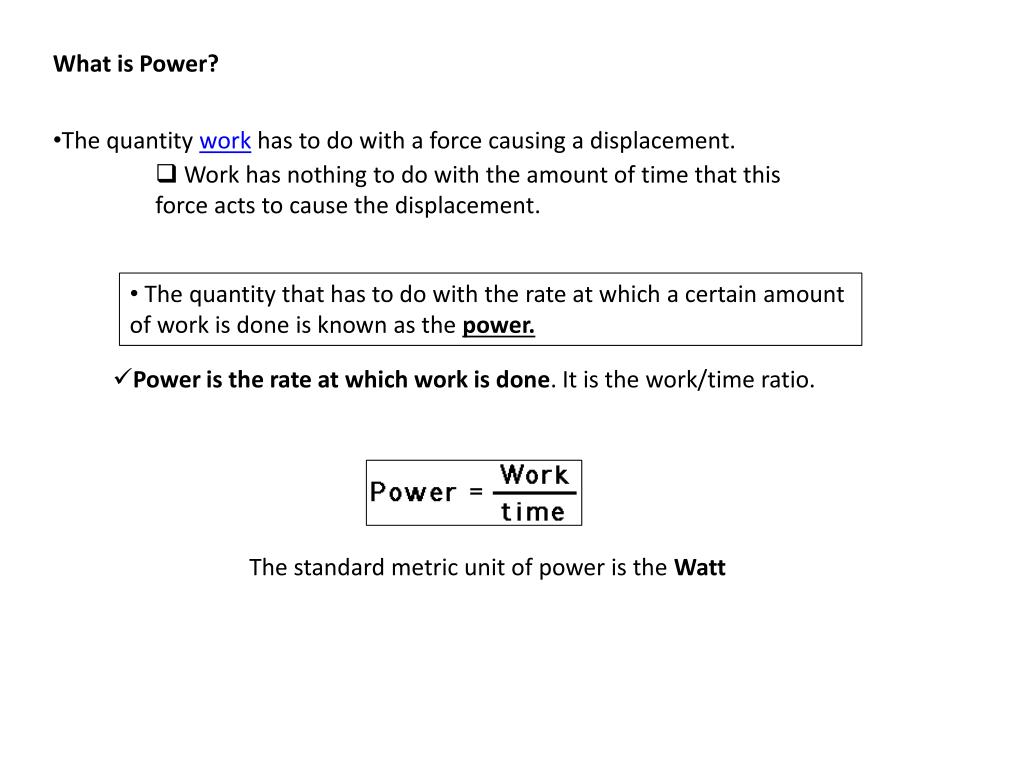
  1. What is Power? • The quantity work has to do with a force causing a displacement. • Work has nothing to do with the amount of time that this force acts to cause the displacement. • The quantity that has to do with the rate at which a certain amount of work is done is known as the power. • Power is the rate at which work is done. It is the work/time ratio. The standard metric unit of power is the Watt

  2. Continued….Power Example Two physics students, Will N. Andable and Ben Pumpiniron, are in the weightlifting room. Will lifts the 100-pound barbell over his head 10 times in one minute; Ben lifts the 100-pound barbell over his head 10 times in 10 seconds. Which student does the most work? ______________ Which student delivers the most power? ______________ Explain your answers Answer: Ben and Will do the same amount of work. They apply the same force to lift the same barbell the same distance above their heads. Yet, Ben is the most "power-full" since he does the same work in less time. Power and time are inversely proportional.

  3. Example When doing a chin-up, a physics student lifts her 42.0-kg body a distance of 0.25 meters in 2 seconds. What is the power delivered by the student's biceps? To raise her body upward at a constant speed, the student must apply a force which is equal to her weight (m•g). The work done to lift her body is W = F * d = (411.6 N) * (0.250 m) W = 102.9 J The power is the work/time ratio which is (102.9 J) / (2 seconds) = 51.5 Watts (rounded) Example A tired squirrel (mass of approximately 1 kg) does push-ups by applying a force to elevate its center-of-mass by 5 cm in order to do a mere 0.50 Joule of work. If the tired squirrel does all this work in 2 seconds, then determine its power. The tired squirrel does 0.50 Joule of work in 2.0 seconds. The power rating of this squirrel is found by P = W / t = (0.50 J) / (2.0 s) = 0.25 Watts