Download
1 / 28
280 likes | 409 Vues
Congress faces critical challenges marked by low public approval (15%) and participation (35%). Many believe it caters to special interests and lacks diversity, leading to stagnation in representation. Proposed electoral reforms include term limits, redistricting, and public financing of campaigns to enhance voter engagement and restore trust. While states have attempted term limits, legal challenges have stalled progress. This reform movement aims to create more competitive elections, reduce special interest influence, and increase the diversity of representation in Congress.

E N D
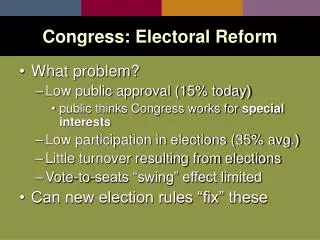
Congress: Electoral Reform • What problem? • Low public approval (15% today) • public thinks Congress works for special interests • Low participation in elections (35% avg.) • Little turnover resulting from elections • Vote-to-seats “swing” effect limited • Can new election rules “fix” these
Congress: Electoral Reform • Reforms • Term limits • Redistricting • Proportional representation • Increase size of House • Public financing of campaigns
Congress: Electoral Reform • Term limits • Prevent professional politicians from running the legislatures? • 21 states adopted between 1990 and 2000 • Many applied TL to Congressional elections • 4 state courts rejected; leg changed in 3 • Limit number of terms (2 or 3) • May or may not apply to lifetime
Congress: Electoral Reform • Term limits • USSC ruled unconstitutional • States can’t change rules about how US Congress is elected • ‘Congress shall regulate time, place, manner of election’ • Would require Const. Amendment
Congress: Electoral Reform • Term limits • Arguments for • More open seats, new mix of candidates • More “citizen” legislators • Idealized by Anti-federalists • Increase voter interest, turnout • more electoral competition
Congress: Electoral Reform • Term limits • Arguments for • More diversity, new mix of candidates • More opportunities for members of groups under-represented in current crop of incumbents • Women • Racial, ethnic minorities
Congress: Electoral Reform • Term limits • Arguments for • Less special interest influence • “Termed out” legislators not as worried about re-election • vote in “public interest”
Congress: Electoral Reform • Term limits • Arguments for • Restore faith in Congress • Cynicism about Congress due to special interests, gridlock • vote in “public interest”
Term Limits • Several attempts in WA • Initiative 552, 1991 (Failed) • Initiative 573, 1992 (Passed) • (Leg, Lt Gov and Gov. and UC Congress) • 1993 USDC rejects part of I-573 • Initiative 670, 1996 (ballot notice) • 1998; WA Sup Court, 6-2 “statute may not change the state constitution” • Overturns remains of I-573
Term Limits • In effect in many states • 1996 first legislator term limited out in ME & CA (26 house members in ME, 22 in CA) • 1998 204 in CA, CO, ME, MO, MI, OR • 2000 380 legislators termed out • 2006 268 termed out • 26 leaders, 122 committee chairs
Term Limits • Terms limits may remove entrenched politicians • Increased legislative turnover • Takes time to learn the ropes • Less focus on districts? • Reduced power of legislature relative to the governor • Are we better off w/ term limits?
Term Limits • What effects? • Relations with other branches • Might strengthen had of exec (and staff) • Stronger role for lobbyists? • Turnout • no change • Institutional memory • Leg leaders lost
Term Limits • What effects? • Increased competition? • No, safe seats are still safe • Fewer career politicians? • In CA, pols shuffle to new offices • Diversity • mixed results
Term Limits • Congressional Elections as “filters” • Even w/ little threat of defeat, “bad” candidates lose • Association w/ scandal = defeat • Study of “quality” incumbents shows worst most likely to lose
Congress: Electoral Reform • Reapportionment and re-districting • Change how the process of districting is done • Congressional districts drawn by state legislatures • Non-partisan commissions? • Make districts more competitive • Dont use GIS info, party-reg info • Courts?
Redistricting • Before the 1960s, states rarely redrew district boundaries • Populations shifted however • Malapportionment—unequal representation • In 1962, the Supreme Court established “one person, one vote”
Redistricting • Baker v Carr; Reynolds v Sims; VRA 1965 • Re-apportionment revolution • no longer a “political question” but justicable • State plans now subject to litigation • rural areas no longer over-represented • major effect on state legislatures
Redistricting • Old Disparities • CT 191 people vs 81,000 • NH 3 people vs 3,200 • TN 10:1 • AL 41:1 • ID 951 people vs 93,000
Redistricting • What criteria? • Now justicable, but on what grounds? • Same size population.... • contiguous • compact • communities of interest • protect incumbents • protect two party system • minority representation
Redistricting • Incumbent-protection districts—many districts are drawn to protect incumbents • Cracking and packing are often used when one party controls the process • Gerrymandering—drawing districts for political purposes
Redistricting • What criteria? • “Partisan Gerrymanders” • can gross “packing” and “cracking” be litigated
Redistricting • How often? • States may redraw districts as often as they like following League of United Latin American Citizens v. Perry (2006) • Challenge to TX plan... • At least once every decade
Redistricting • Who should draw districts? • Legislature • majority party controls process • require Governors signature • “Independent Commission” • WA, CA, IA...who appoints it? • Courts
Redistricting • Redistricting reform for Congress can be done at state level • No constitutional amendment • Not likely all / most states would do this
Congress: Electoral Reform • Increase size of House • Arguments for: • hard to represent 700K • Costs of campaigns too high • Large districts very heterogeneous • Small groups never a geographic majority
Congress: Electoral Reform • Again, what problem? • Low public approval (15% today) • public thinks Congress works for special interests • Low participation in elections (35% avg.) • Little turnover resulting from elections • Vote-to-seats “swing” effect limited • Can new election rules “fix” these