The Geographic Influence on Ancient Greece: Seas, Mountains, and Cultural Development
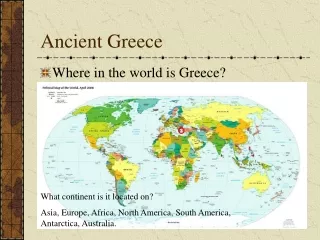
Ancient Greece's unique geography significantly shaped its physical environment and societal structure. Encircled by the Aegean and Ionian Seas, the region's seafaring tradition fostered trade and cultural exchanges with neighboring Mediterranean communities. Rugged mountains covering over three-quarters of the land led to the establishment of independent city-states (polis), such as Athens and Sparta. With more than 2,000 islands and a mild climate, agriculture thrived, producing essential crops like olives and grapes. Understanding these geographic features is crucial to comprehending Greece's historical and cultural evolution.

The Geographic Influence on Ancient Greece: Seas, Mountains, and Cultural Development
E N D
Presentation Transcript
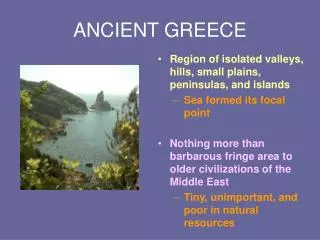
Geographic Features • Sea: heavy influence on physical environment of Greece (Aegean Sea, Ionian Sea) • Mountains (with narrow valleys): cover more than ¾ of Greece’s surface area 3. Islands: more than 2000 islands (Crete being the largest) • Climate: winter= mild climate; summer= hot climate with rainfall from October to March = long growing season
Effects of Geography • Seafaring tradition: reliance on navy and fleets for power and protection • Trade & Cultural Links: sea provided link to trade and cultural exchangewith Mediterranean communities • Isolationism: protection but lack of effective communication • Polis (independent city states): Greece was organized into separated by seas and rugged mountains • Emergence of dominant city states (Athens, Sparta)
RESOURCES • grain • fine cheese made of goat’smilk • timber • wild game • wool of sheep = cloth • MOST IMPORTANT CROPS • olives = oil • grapes = wine • grain • clay = pottery
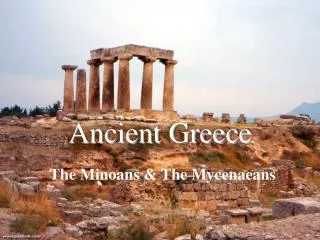
3 Major Periods of Ancient Greek Civilization 1. Early CivilizationsMinoans (Crete) and Mycenae (mi se ne) 2. Classical GreeceFlourishing of arts, literature, philosophy; domination by Sparta and Athens 3. Hellenistic AgeMacedonia Empire and Alexander the Great
LIFE IN MINOAN CRETE: c. 3200 – 1100 BCE • Significant Advancements:-two-crop system: olives and grapes-created surplus in food and increase in population • Developed Linear A: a style of writing • Importing and Exporting (Egyptians, Persians and Syrians) • Fishing in Mediterranean Skilled Sailors
Home to 20, 000 people • Center of government • Grand Palace-250 Rooms-Colourful Murals -Indoor plumbing-Flush toilets-Running water
THEORIES FOR DECLINE OF MINOANS • 1750 BCE- earthquake destroys Minoan palaces • 1628 BCE- volcano erupts at Thera • 1400 BCE- War between Minoans and Myceaneans led to decline of power
LIFE OF THE MYCENAEANS • Some influence of Minoan culture -created new civilization with domination in the Aegean Sea (Aegean World) 1500 BCE • Importance of Military • Pastoralist System • Warrior-Kings ruled autonomously • 1490 BCE- Minoan palaces had been rebuilt however all were destroyed except at Knossos by Mycenaean warriors • Mycenaean's took control of Crete at Knossos by 1500 BCE • Mycenaean's controlled mainland Greece = main political centre was Mycenae • More interested in war as pottery and grave sites reflect hunting, weapons, armor and war as well as fortified palace walls • Developed Linear B • Slowly Minoan culture and traditions disappeared
THEORIES FOR DECLINE OF MYCEANEANS • Shift in climate leading to drought forcing Myceanans to migrate to more fertile lands • Tribe of nomadic warriors from north of Greece (Dorians) destroyed Mycenaeans
HOMER • 8th Century BCE • Greek Poet who immortalized Mycenaean's • Created 2 great poems thattook place during the periodof Mycenaean rule in the Aegean Sea • Famous Works: Iliad & Odyssey-both stories of great Heroism -Iliad: Story of Achilles-Odyssey: Story of Odysseus
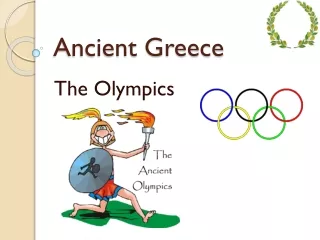
Archaic Period750 – 500 BCE Significant events1) national literature (Homer) 2) resurgence of trade 3) colonization of Sicily and Italy 4) Olympic Games -776 BCE 5) stone sculptures of human figure 6) rise of city states (polis)
Oracle of Delphi • Dating back to 1400 BC, the Oracle of Delphi was the most important shrine in all Greece as the sanctuary of Apollo • Built around a sacred spring, Delphi wasconsidered to be the center (literally navel) of the world • questions about the future were answered by the Pythia, the priestess of Apollo • answers, usually cryptic or ambiguous • Arguments over the correct interpretation ofan oracle were common, but the oracle was always happy to give another prophecy ifmore gold was provided • It is believed that pythias were high on hallucinative gases
Greek Myths FUNCTIONS • Explained the world • Means of Exploration • Provided authority and legitimacy • Entertainment
MYTHOLOGY: THE MINOTAUR • Myth of the Minoan society: Theseus and the Minotaur • Ancient Greek tale about courage, strength and wit http://www.youtube.com/watch?v=HrptIyn3kW4&feature=related