
Atomic Models Through Time
E N D
Presentation Transcript
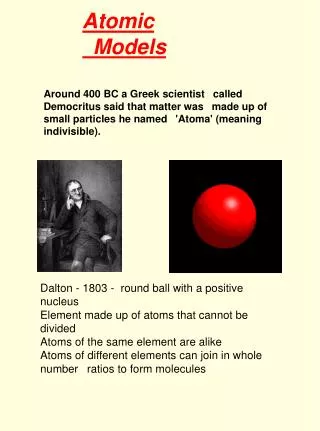
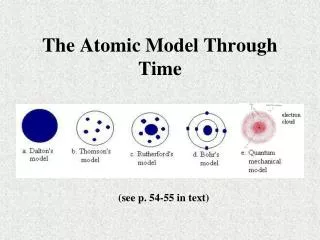
Democritus • Theorized that if you were to cut something in half, then cut it in half again and again… • Eventually you would be left with something too small to be cut. • Therefore, Democritus gave us “atomos,” or “uncuttable,” to be the word for the smallest individual particle of a substance.
John Dalton • Dalton’s Atomic Theory ~ 1808 • All matter is composed of atoms. • Atoms of each element are the same size, mass, etc., but are different from atoms of other elements. • Atoms can’t be subdivided (cut) or destroyed. • Envisioned atoms as “tiny, solid balls”
Cathode Ray Tube • If you run electricity through a gas filled tube, • you see streams of particles • How do we know they are particles? • A cross left a shadow (something must be traveling in a straight line), could be light… • but J.J. Thomson put a magnet next to it and bent the beam. • Light is not magnetic! • Beam had a negative charge Video
J.J. Thomson • Thomson’s Atomic Theory ~ 1897 • Discovered negatively charged electrons. • Envisioned atoms as a “positively charged sphere with electrons embedded in it.” • “Muffin” Model • Positively charged bread • Negatively charged “blueberries” floating around (electrons)
Hantaro Nagaoka • Nagaoka’s Atomic Theory~ 1904 • Proposed a nucleus • Electrons orbiting a positively charged sphere in the center. • “Planetary” Model • Electrons = planets • Positive Center Sphere = Sun
Alpha Particle Cannon • Ernest Rutherford shot fast moving positively charged alpha particles at thin gold foil… • If Thomson’s model was correct, the alpha particles would pass right through the foil. • Video • Instead, some deflected back at large angles!
Alpha Particle Cannon • Conclusions: • Thomson’s model was inaccurate • A new model must be created • 1. The atom is mostly empty space • 2. There is a dense, positively charged nucleus in the center
Ernest Rutherford • Rutherford’s Atomic Theory ~ 1911 • The atom is composed of mostly empty space. • Small, dense, positively charged nucleus containing almost all of the atom’s mass. • “Peach” Model • Peach Pit = Nucleus • Meat = Empty space with electrons randomly orbiting nucleus.
Refining Atomic Theory in the Early 1900’s • Masses of protons are measured. • Protons are 2000 times more massive than electrons. • Charge of protons is determined to be positive. • Protons provide equal & opposite charge to electrons.
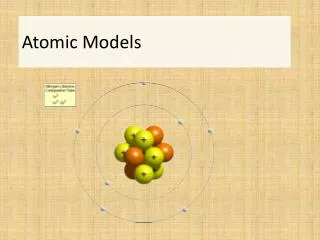
Niels Bohr • Bohr’s Atomic Theory ~ 1913 • Electrons do not “randomly” orbit the nucleus. • Electrons move in specific “layers” or “energy levels” / “shells”. • Atoms absorb, or give off energy when electrons move from one “level” to another. • Bohr’s Model • “onion” model • Electrons move on layers of an onion.
Valence Electrons • Valence electrons are the electrons located furthest from the nucleus • They are a determining factor in chemical bonding. • If you visualize the atom like Bohr (an onion), the valence electrons are the electrons located on the outer layer.
New Problem • As scientists find the masses of atoms, they always have about twice the mass predicted by the number of protons • Remember, the mass of electrons is so small it is insignificant • So, there must be something else in the atom…
James Chadwick • Contribution to Modern Model ~ 1932 • Discovered the neutron • Same mass as proton • No electrical charge • This is why it was not “discovered” earlier • Existence of neutron explained why atoms were heavier than the total mass of the protons and electrons.
Modern Model • Electron Cloud Model ~ 1920’s to present • Electrons form a negatively charged cloud around the nucleus. • It is impossible to determine exactly where an electron is at any given time. (probability instead) • Higher probability of electrons near nucleus.