Understanding Our Solar System: The Planets, Their Formation, and Unique Characteristics
Dive into the intricacies of our solar system, where planets revolve counterclockwise around the Sun on a shared plane known as the ecliptic. Discover the characteristics of inner terrestrial planets like Mercury and Earth, and the outer jovian giants like Jupiter and Saturn. Delve into the fascinating nuances of Pluto, now classified as a dwarf planet, and the origin of the solar system from the solar nebula model. Learn about asteroids, comets, and meteoroids, and their roles in the cosmic dance that shapes our celestial neighborhood.

Understanding Our Solar System: The Planets, Their Formation, and Unique Characteristics
E N D
Presentation Transcript
The Planets Ali Nork
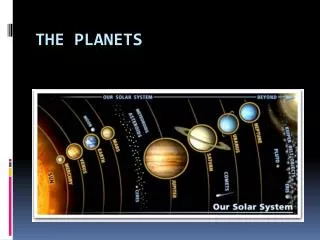
Planetary Revolution • Planets revolve counterclockwise around Sun • Planets revolve on a common plane called the ecliptic • Pluto’s orbit is tipped 17.2° • Other planets tipped no more than 3.4°
Planetary Rotation • Almost all planet rotate counterclockwise, but • Venus rotates backwards (retrograde) • Uranus and Pluto rotate on sides w/ equator perpendicular to orbit
Inner Planets • Terrestrial, or “earthlike” • Mercury, Venus, Earth, Mars • Closer to sun • Small diameter/mass • Density greater than water (3-5g/cm3) • Rocky crust, dense mantle • Very dense core w/ Fe and Ni
Inner planets cont’d…. • Impact craters • Few moons (actually- Mercury and Venus have no moons) • Less atmosphere • Animation here
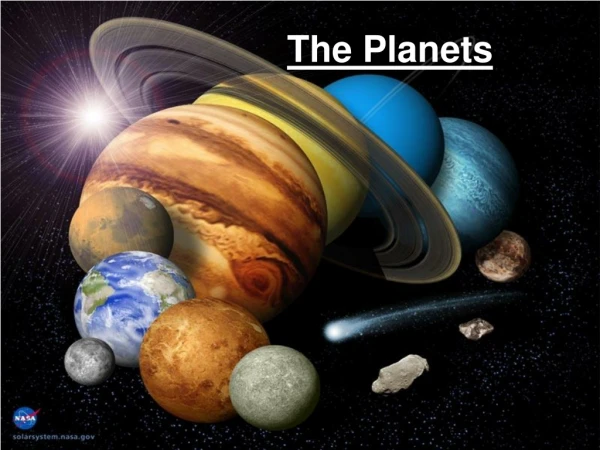
Outer Planets • Jovian planets- Jupiter-like • Gas giants- Jupiter, Saturn, Uranus, Neptune • Huge compared to Earth • Large mass, low density (<1.75g/cm3) • Mostly gaseous (H and He)
Outer Planets cont’d…. • Have rings • Have many moons- Jupiter (63), Saturn (62), Uranus (27), Neptune (13) • Separated from terrestrial planets by the Asteroid Belt
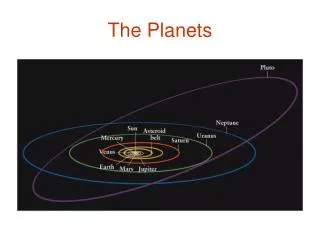
What’s Up With Pluto? • Was considered a planet for 76 years • 2006- reclassified as a dwarf planet • Mostly ice • Very small (1/20 the mass of Mercury) • Has 3 moons (Charon, Nix and Hydra) • Highly eccentric (elliptical) orbit which crosses Neptune’s
http://en.wikipedia.org/wiki/Image:TheKuiperBelt_Orbits_Pluto_Ecliptic.svghttp://en.wikipedia.org/wiki/Image:TheKuiperBelt_Orbits_Pluto_Ecliptic.svg
Origin of the Solar System • Solar nebula model- ss formed out of an eastward rotation interstellar cloud 5 billion years ago • Dust and gas cloud (mostly H and He) • Cloud condensed due to gravity; speed of rotation increased; became flattened • Densest area in middle became the sun
Disk eventually cooled; different elements and compounds condensed depending on distance from sun • Tiny grains of condensing material accumulated and collided; eventually formed planetismals (“baby planets”) • Jupiter was the first large planet to form in outer ss; probably prevented other outer planets from growing larger • Asteroid belt (interplanetary debris between Mars and Jupiter) remains b/c Jupiter’s gravity prevented it from creating a planet
Planetary Formation • Terrestrial planets formed where temps were very high and metals and silicates could form solids • Jovian planets formed at lower temps where gas became ice • No planets in asteroid belt b/c Jupiter is so massive and its gravity disturbed planet formation • Larger mass enables planets to hang onto particles in rings; less impacted by solar wind (far away from sun)
Planetary Satellites • Moons are natural planetary satellites that revolve around a planet • Some cool moon facts: • Jupiter’s moon Ganymede is the largest one in our solar system • Saturn’s moon Titan has a mostly nitrogen atmosphere and has liquid hydrocarbon lakes; also has water ice • Mars has 2 tiny moons (Phobos and Deimos) which may be captured asteroids
Voyager I “family portrait” -Taken in 1990 after Voyager I and II left Pluto’s probit
Asteroids • Rocky masses that revolve around Sun; usually between Mars and Jupiter • Debris left over by a planet that failed to from (about 2.8 AU from Sun) • Need a telescope to view them • Largest is Ceres (578 mi wide)
Comets • Nucleus of ice and debris; coma is gas surrounded by nucleus
Comets cont’d… • Tail points away from sun and is caused by solar wind • Long, eccentric orbit which goes outside the 9 (or 8) planets • Orbital periods can be long or short • Comet Shoemaker-Levy 9 slammed into Jupiter’s atmosphere in 1994
Kuiper Belt • Located beyond planet Neptune • Home to over 700,000 icy, small objects (Pluto, Quaoar) • Sometimes objects are redirected towards the sun (disturbed by gravity of one of the gas giants)
Oort Cloud • Home to many comets • Located 50,000 AU from the sun • Outer edge defines the boundary of our solar system • Members include Sedna and various comets
Meteoroids • Rocky, icy fragment in space • Range in size from small sand particles to boulders • Meteor (shooting star) is light produced when enters Earth’s atmosphere due to friction • Meteorite is meteoroid that has struck Earth’s surface • May produce impact craters
Meteoroids cont’d… • Meteoroids can’t be seen, but meteors can b/c of light produced • Maybe formed from impacts between asteroids • Micrometeoroids- tiny fragments that often hit Earth • Can travel at high speeds and damage spacecraft