Optimizing Beam Transfer from PS to SPS: Advances and Future Directions
220 likes | 348 Vues
This study presents the ongoing research on beam transfer from the Proton Synchrotron (PS) to the Super Proton Synchrotron (SPS) at CERN. Historically, beam losses were significant, often reaching 10-20%, prompting a need for optimization. Recent improvements have reduced losses to approximately 5% through enhanced scrubbing techniques and new operational methods. The study highlights past measurement results, simulation findings, and optimization strategies to further minimize losses during beam transfer, ensuring the successful operation of future LHC run intensities.


Optimizing Beam Transfer from PS to SPS: Advances and Future Directions
E N D
Presentation Transcript
PS-to-SPSBeam Transfer Studies Helga Timkó BE-RF-BR in collaborationwith Theodoros Argyropoulos, Thomas Bohl, Heiko Damerau, Steven Hancock, Juan Esteban Müller, Elena Shaposhnikova
Outline • Motivation for the beam transfer studies • Earlier • Today • Measurement results • Why we did not understand them • A few highlights of our simulation results • Explaining past observations • New ideas for optimisation • On-going work LIU-SPS WG on Beam loss…
PS-TO-SPS TRANSFER: MOTIvation
Motivation for the transfer studies – Earlier… • A few years ago still, losses were very high • Typically around 10-20 % • The currently operational SPS flat-bottom (FB) scheme and many other settings were optimised through these studies 2004 Nominal LHC intensity (~1.1-1.3 1011 ppb), 25 ns Up to 40 % losses!! E. Shaposhnikova et al.: Capture loss of the LHC beam in the CERN SPS
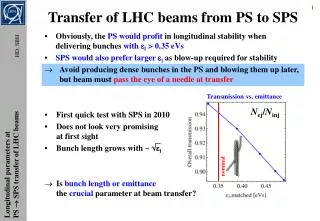
…as a function of intensity… • Losses increase significantly with intensity will be a problem in future • Why do losses increase with intensity? • Higher intensity εL more losses • Beam loading deformation of bucket more losses Losses increase with bunch intensity J. Esteban Müller LIU-SPS WG on Beam loss…
…and today • Today, losses are down to ~5 % for nominal intensity (due to scrubbing) • When we’ll increase intensity, losses will be significant again • The SPS bucket is already very full at injection • Would like to use a larger εL, which is good for • Stability in the PS & SPS • Higher intensity beam – planned for future LHC operation • The PS has been upgraded many times over the past 50 years and will be pushed to its limits with the future intensity requirements • Minimising the losses in the injector chain is essential in order to deliver the required intensity to the LHC!
PS-TO-SPS TRANSFER: Previous measurements
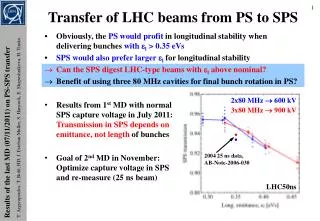
MDs: 25 ns and 50 ns beam • 50 ns: 4th July 2011 • 25 ns: 7th November 2011 • Transmission didn’t improve using 900 kV for the bunch rotation in the PS But the transmission stays the same Bunch length does down when 900 kV is applied LIU-SPS WG on Beam loss…
PS-TO-SPS TRANSFER: Simulation Highlights
Our model • In our simulations, we use • Real, averaged phase-space distributions of the bunches • From tomography measurements at the PS FT • Real voltage programmes in PS and SPS • Single bunch simulations, no intensity effects have been taken into account
Emittance blow-up • There is an emittance blow-up (due to the synchronisation loop) in the PS included also in the simulations Measured bunch lengths are shorter than the simulated LIU-SPS WG on Beam loss…
Simulating the 50 ns case • Transmission measured at SPS FB, before the acceleration • V200 MHz = 2 MV, V800 MHz = 0.34 MV in bunch-shortening mode • Reproduce exp. results when emittance blow-up is added Bunch lengths are matched by ε blow-up Transmission becomes very realistic LIU-SPS WG on Beam loss…
So, why is the transmission not improved? • There is no improvement with larger voltage, because • Bunches have a particular shape and • Buckets are very full; • To improve the transmission, need to improve the shape LIU-SPS WG on Beam loss…
PS rotation timing • However, in the MDs above we adjusted only t80 MHz • t40 MHz = 150 μs was kept the same for both 600 kV and 900 kV cases SPS LIU-SPS WG on Beam loss…
PS-TO-SPS TRANSFER: OPTIMISATION STUDIES
Optimising the bunch rotation • For 1+2 cavities, optimal timing reduces losses: 4.4 % 3.5 % • Using 2+3 cavities instead of 1+2: 3.5 % 1.3 % • N.B. only t40 MHzis optimised based on transmission, t80 MHz is optimised based on bunch length Current operational point LIU-SPS WG on Beam loss…
Optimised bunch shapes … now improved: tails less populated LIU-SPS WG on Beam loss…
Effect on transmission • With optimised timing and 900 kV in the PS: • Losses are reduced, despite having longer bunches Transmission is considerably improved LIU-SPS WG on Beam loss…
SPS capture voltage • Using the SPSvoltage &momentum programme for the acceleration ramp, we simulated injection & acceleration: Capture + FB losses Capture + FB + acceleration ramp losses • 23 MV has 3-4 % better transmission than 3 MV • No difference between 2 MV and 23 MV is seen in our sims • 23 MV stands for: 2 MV at batch injections, 3 MV in-between injections LIU-SPS WG on Beam loss…
PS-TO-SPS TRANSFER: ONGOING MDS
Verification of our results • 2012-03-29 MD: optimising the PS bunch rotation timing • Preliminary results, need further measurements (beam conditions were changing) Currently operational Optimum in simulations
Conclusions & outlook • Earlier, transmission was not improved with V80 MHz,PS= 900 kV, due to the ‘S-shape’ of the bunch and a full SPS bucket • Bunch shape has to be optimised during the PS rotation • Simulations predict a gain of a few % by optimising the PS bunch rotation timing • First MD results are encouraging • The SPS FB voltage influences the losses in the beginning of the acceleration ramp • We can expect significant increase in losses for higher emittances (intensities) • Simulations including intensity effects are planned LIU-SPS WG on Beam loss…