Understanding the Roots of Aggression: Biological and Psychological Perspectives
160 likes | 311 Vues
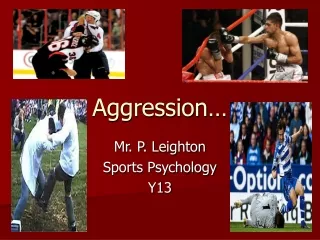
This analysis explores the origins of aggression through two primary lenses: biological and psychological. The biological perspective considers evolutionary adaptations, examining how aggression is continuum with our animal ancestry. The psychological viewpoint analyzes uniquely human traits influencing aggressive behaviors. Notably, ethologists provide insights into human aggression's nuances, including competition and territoriality. The implications on human behaviors, such as space invasion and conformist attitudes, are discussed alongside personality theories highlighting traits influencing aggression across various situations.


Understanding the Roots of Aggression: Biological and Psychological Perspectives
E N D
Presentation Transcript
Roots of Aggression Two Theories
Two Views of Aggression’s Source • Biological source--evolutionary/adaptive on a continuum with our animal ancestry • Psychological source--rooted in humanity and something peculiar or unique to us!
Ethologists’ Theory of Human Aggression! • Predation vs. Aggression • Wynne-Edwards: stable populations --animals don’t all starve equally --competitions & displays (red grouse fight at dawn for 2 hrs. then feed togthr. --swarming --Tribolium (Chapman) 1 to 32 breeding pairs, after 6 months, Get 44 beetles/gram flour
Role of Aggression • Fitness selection (mature breeders) & resource allocation • Cost of aggression (hurt/killed) • Limitations on cost: --Dominance hierarchies (hens/monkeys) or individual territories (bower birds) --Mechanisms that minimize damage: • -- threat display • -- ritualized combat Mobbing-a powerful social behavior
Ritualized Combat http://www.youtube.com/watch?v=V0pxSR3D01s
Implications for Humans • Lorenz & Eibl-Eibesfeldt: dangerous vs. non-dangerous animals & implications • Humans quickly switched categories via cultural invention, didn’t develop the safeguards • Thus an ethological explanation of human behavior!
Human Analogues • Spatial behavior: Hall (intimate 0-1.5, personal 1.5-4, social 4-12, public 12+) • Invasion of space (library tables) • Defensive architecture (Newman) • Middlemeist et al. study of spacing • Emotions (universality, facial muscles, etc.) --defensive smile
Humanistic Theory: Koestler • Focus on War, not bar fights • It’s our human qualities and not our animal nature that makes us dangerous • Pre-history bonding of hunting groups- (Love of the in-group) • Human sacrifice- no inhibition against killing con-specifics • Brain hierarchy (McClain’s tripartite brain) • (Marcus’ kluge: Evolution doesn’t optimize) • Symbols: their unique power to influence humans
Summary • Humans oriented toward what others do and can become dangerous as a result • Contributing issues: • Conformity • Identification (identity formation) • Obedience • Self Perception • Foot in the door • Dehumanization of “others” or out-group • Elevation (love) of “sames” or in-group
Personality Stability vs. Situation?
Personality • Traits vs. States vs. Types • 18,000 personality terms to 32 traits to- • Big five: • Extraversion (outgoing, sociable, positive) • Neuroticism (prone to negative emotions) • Conscientiousness (organized, efficient, disciplined) • Openness to experience (non-conventional, curious) • Agreeableness (trusting & easygoing with others) 40 to 60% heritable
Situationism • Low correlations across situations • Strong vs. weak situations • But-brain differences and heritability • Introverts more sensitive to external stimuli • More reactive central nervous system • Low pain tolerance • Underactive Nor-epi system • Sensation seeking extraverts
Heritability: Big five correlations • Identical twins vs. fraternal twins : Identical Fraternal • Reared together- .51 .23 • Reared apart- .50 .21
Personality Theories • Psychoanalytic • Childhood experience, ucs influence, dynamics, conflict, defenses, development and identification • Humanistic • Focus on self & self-actualization, existential approach, flow & happiness • Social-Cognitive Theory • Beliefs, thoughts & personal constructs shape behavior • Behavioral Theory • Learning history, self-perception theory, self-control