Download
1 / 15
150 likes | 271 Vues
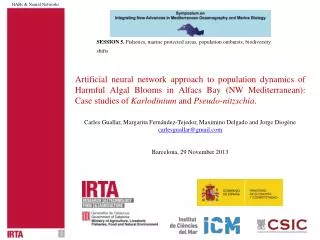
This study explores the use of artificial neural networks (ANN) to model and predict the population dynamics of harmful algal blooms (HABs) in Alfacs Bay, NW Mediterranean. Focusing on species like Karlodinium and Pseudo-nitzschia, we analyze their interactions with environmental factors such as temperature, salinity, and river flow. Training the neural networks allows for forecasting algal bloom presence and dynamics, emphasizing the significance of environmental variables in HAB development and its implications for marine biodiversity and fisheries.

E N D
HABs & Neural Networks SESSION 5. Fisheries, marine protectedareas, populationoutbursts, biodiversityshifts Artificial neural network approach to population dynamics of Harmful Algal Blooms in Alfacs Bay (NW Mediterranean): Case studies of Karlodinium and Pseudo-nitzschia. Carles Guallar, Margarita Fernández-Tejedor, Maximino Delgado and Jorge Diogène carlesguallar@gmail.com Barcelona, 29 November 2013
HABs & Neural Networks Alfacs Bay (Ebro Delta) Karlodiniumspp. Pseudo-nitzschiaspp.
HABs & Neural Networks Input layerHiddenlayer Output layer Variable 1 Variable 2 Forecast Variable 3 Variable 4 Variable 5 Characteristics: - Feedforward neural network - Sigmoidfunction - Backpropagationwithmomentumterm and flat spot elimination
HABs & Neural Networks Environmental &Phytoplankton 40.65 Latitude N 40.70 40.75 Meteorological Ebro Riverflowrates 0.55 0.60 0.65 0.70 0.75 Longitude E
HABs & Neural Networks Unique data set
HABs & Neural Networks Quantitativedetectionlimit 3.1 Presence > 3.1 Prediction Cells L-1 Phytoplankton counts Classification < 3.1 Absence
HABs & Neural Networks Log10 (Karlodiniumspp.) - Deepwatertemperature (5thprev. week) - Windgust (3rdprev. week) - Irradiance (8th prev. week) - Atmosfericpressure (Log10, 5thprev. week) - Ebro Riverflowrate (Log10, 5thprev. week) 5 previousweeks Lag (weeks) Log10 (Pseudo-nitzschiaspp.) - Deepwatertemperature (14thprev. week) - Windvelocity (10thprev. week) - Watercolumnsalinity (6th prev. week) - Atmosfericpressure (Log10, 13thprev. week) - Ebro Riverflowrate (Log10, 1stprev. week) 5 previousweeks Lag (weeks)
HABs & Neural Networks One-stepweekAbsence-Presencemodels Karlodinium Pseudo-nitzschia Misclassification error (%) Error characteristics Absence Error characteristics Presence
HABs & Neural Networks One-stepweekPredictionmodels Karlodinium Pseudo-nitzschia Coefficient of determination (R2)
HABs & Neural Networks Neural InterpretationDiagram Absence-Presencemodels Karlodiniummodel Presence Absence Pseudo-nitzschiamodel Presence Absence
HABs & Neural Networks Neural InterpretationDiagram Predictionmodels Karlodiniummodel Log10(Cells L-1) Pseudo-nitzschiamodel Log10(Cells L-1)
HABs & Neural Networks ConnectionWeightApproach Absence-Presencemodels Predictionmodels Karlodiniummodels Pseudo-nitzschiamodels
HABs & Neural Networks ConnectionWeightApproach Biological vs Environmental variables Absence-Presence Prediction Karlodinium Karlodinium Pseudo-nitzschia Pseudo-nitzschia
HABs & Neural Networks Conclusions: Neural networkmodelsweredevelopedtopredictPseudo-nitzschiaspp. and Karlodiniumspp. ThepopulationdynamicsforPseudo-nitzschiaspp. and Karlodiniumspp. were similar forthewholeecosystem. Thebigsize of the neural networkmodelshighlightsthecomplexity of thephytoplanktondynamicsin AlfacsBay. Environmental variables are importantfactorsto drive phytoplanktondynamics in AlfacsBay.
HABs & Neural Networks Thankyouverymuch. • Aknowledgments: • Sistema de Observación y Alerta de Proliferación de Microalgas Nocivas en Zonas de Producción Acuícola Marina (PURGADEMAR; IPT-2011-1707-310000). • Programa de seguiment de la qualitat de les aigües, mol·luscs i fitoplanctontòxic a les zones de producció de mariscdellitoralcatalà de la DGPiAM.









![[virtual] cells](https://cdn1.slideserve.com/3553683/slide1-dt.jpg)