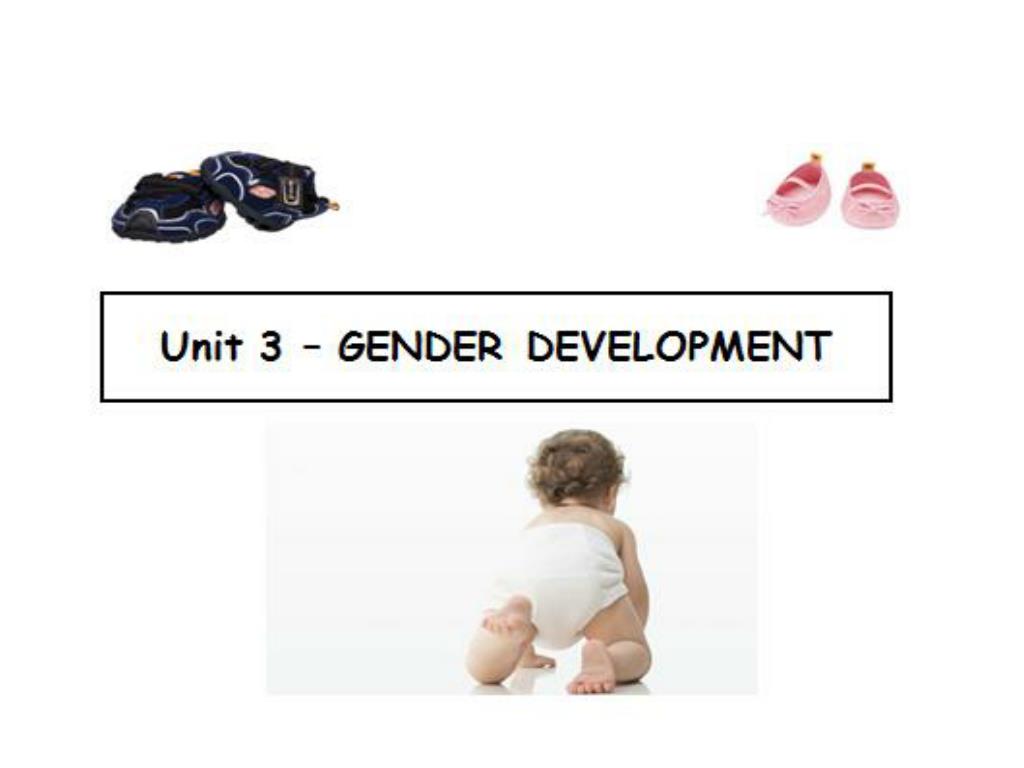
This resource explores the Biosocial Theory, which highlights the interaction between genetic factors and environmental influences in determining gender. It explains how genes such as the SRY gene on the Y chromosome trigger hormonal changes (like testosterone and progesterone), which influence the development of gonads and associated structures. The theory emphasizes that gender identity is not solely determined by biology but is also shaped by social labeling and cultural expectations. Case studies, including the David Reimer case, are discussed to illustrate these concepts.
01 / 54Understanding Biosocial Theory: The Role of Genes, Hormones, and Socialization in Gender Development
1 / 17
Télécharger la présentation
Understanding Biosocial Theory: The Role of Genes, Hormones, and Socialization in Gender Development
Une image / un lien ci-dessous est fourni (tel quel) pour télécharger la présentation
Politique de téléchargement : le contenu du site vous est fourni TEL QUEL pour votre information et votre usage personnel ; il ne peut être vendu, concédé sous licence ni partagé sur d’autres sites sans l’accord de son auteur.Le contenu vous est fourni TEL QUEL, pour votre information et votre usage personnel uniquement.Téléchargez la présentation en cliquant sur ce lien.Lors du téléchargement, si vous ne parvenez pas à télécharger une présentation, l’éditeur a peut-être supprimé le fichier de son serveur.Pendant le téléchargement, si vous ne parvenez pas à obtenir une présentation, le fichier a peut-être été supprimé par l’éditeur.
Genes instruct hormones to determine sex of individual e.g. SRY gene on the Y chromosome controls whether gonads become ovaries or testes.. By releasing testosterone/progesterone at week 8 of gestation 1. Week 8 of gestation 2. Pituitary gland Testosterone - instruct gonads form Wolffian ducts - testis + penis Progesterone – instruct gonads become Mullerian ducts – Fallopian tubes + ovaries + vagina Testis Ovaries
Possible answers 1. The research sample is small which makes it difficult to generalise the results 2. Validity may be questioned as research comes from a variety of sources which may be biased i.e. it relies on the memory of the friend or doctors of those involved… 3. They provide a rich source of data… 4. There provide evidence on unique events…
Activity: Presentations • What is a ‘Biosocial’ Theory? – Script + Filmed Report. • David Reimer case study example – Role play • Read theory then produce 1x – PEST Card each/report • Clips – David Reimer – Computer/visuals
A newborn baby is labelled as male or female and this labelling has consequences for how the child will be perceived and treated, with boys and girls being treated differently for example how they are handled. So gender can be seen as being socially constructed and therefore differing across cultures and over time.
AO2: The results of this study are easy to generalise because the sample size is quite large and the participants are of both genders. The findings come from a Laboratory experiment and therefore indicate a link between cause and effect i.e. gender of baby and expected behaviour.
Smith and Lloyd (1978) dressed babies in non-specific gender clothes and then either labelled them with a boy or a girl’s name. It was found that people would play with them differently according to their gender label, with boys being treated in a much more physical manner e.g. mothers offered the baby boy a toy hammer and the girl a soft toy. All play was sex-typed.
AO2: This study provides support for the biosocial theory, showing that people react differently to boys and girls. The participants in this study may have shown demand characteristics as they could have worked out the purpose of the experiment.
AO2 continued: Wetherell and Edley (1999) found that several different styles of adult masculinity being exhibited by men such as unconventional, sporty and ‘new man’ indicating that gender role is not fixed exclusively by Biology.
The boy was one of a pair of twins born in Canada in 1965. When they were 8 months old, the boys went to hospital for a routine circumcision operation. However, one of the twins, Bruce, suffered a terrible accident. During the operation, most of his penis was accidentally burnt off.
At this time, reconstructing a new penis was not an option. So his parents took advice from a number of experts. A psychologist named Money recommended that Bruce was raised as a girl instead. He believed that babies were not born with their gender and that is was upbringing that made them masculine or feminine.
When Bruce was 17 months old, he had his testes removed. He was re-named Brenda by his parents, who then began to treat him as a girl. The plan was that they would bring up Bruce as their daughter, not their son. Brenda was too young to know what had happened. As ‘she’ got older, she was led to believe that she had been born a girl.
Results: At first, Money was heavily involved in the case. He frequently interviewed and observed Brenda. He reported that she had adapted to her new gender role well. For example, he claimed that she enjoyed playing with girls’ toys and had no reason to believe she was any different from other girls of her age.
However, when Brenda reached puberty, there were some problems. To begin with, she needed to be given hormones to help her to develop a more female shape (e.g. breasts and hips). Despite this, she was said to have quite a masculine appearance and masculine mannerisms.
Brenda later reported that she had felt like a man inside. For example, she found other girls attractive and rejected boys who were interested in her. She preferred more masculine activities such as sports, and wanted to ‘hang out’ with her brother.
At the ages of 13, life had become so difficult for Brenda that her parents decided to tell her the truth about her past. When Brenda found out she had been born a boys she was actually quite relieved. It helped to explain the strange feelings she had about her gender.
Soon after finding out about her true sex, Brenda decided to live the rest of her life as a man. She renamed herself David. Eventually David ended up having a penis reconstructed, married a woman and became a father by adopting her children.
But • In addition to his lifelong difficult relationship with his parents, Reimer had to deal with unemployment and the death of his brother Brian from an overdose of antidepressants in 2002. On May 2, 2004, his wife Jane told him she wanted to separate. On the morning of May 5, Reimer drove to a grocery store, and shot himself in the head.[6]
Bradley et al (1998) continued This individual had exhibited some male behaviour as a child but preferred female company and as an adult felt female and was happy that way. This particular case does suggest that a biological sex does not determine gender identity.
Evaluation: • Studies of individuals being given re-assignment surgery and raised as the opposite gender to their biology have produced contradictory results and have been prone on occasion to researcher bias.
Evaluation continued:For example Reiner and Gearhart (2003) reported on 16 biological males born without a penis, given re-assignment surgery and raised as females. All exhibited male tendencies and 10 decided to become male again by 16 years of age.
Money (1991) ...however reported on 250 cases of people being happy with gender re-assignment. Clear conclusions therefore have not been possible.
Evaluation continued: Early gender related behaviours appear to be more biologically directed Kujawski and Bower (1993) found that 1 year olds preferred to watch same gender children suggesting that initially innate factors dominate.
Evaluation continued: The fact that the model (theory) sees gender behaviour as not solely innate and fixed means that it is possible for an individual to develop their gender identity into new and positive ways.
Evaluation continued: Ideas about gender seem to differ cross-culturally and this suggests that gender roles and behaviour are a social construction (see pages 66 & 67).
Evaluation continued: This view is supported by Wetherell and Edley (1999) who found several different styles of adult masculinity being exhibited by men such as unconventional, sporty and ‘new man’ indicating that gender role is not fixed exclusively by gender.
Evaluation continued: The biosocial model is an example of how psychological approaches can work in unison and should therefore not be seen as a single exclusive explanation of human behaviour.
Connexion au compte
Connectez-vous pour publier votre contenu sur SlideServe.