Exploring Social Science Through Artifacts and Timelines
This lesson plan focuses on how social scientists, such as archaeologists and anthropologists, utilize artifacts to study societies and cultures. Students will engage in discussions, group presentations, and artifact analysis, specifically looking at the Lascaux Cave Paintings as a historical case study. The session will also cover the significance of dating systems (BC, BCE, AD, CE) in understanding human history. Activities include analyzing hominid characteristics and collaborating on timeline exercises to foster a deeper understanding of our cultural heritage.

Exploring Social Science Through Artifacts and Timelines
E N D
Presentation Transcript
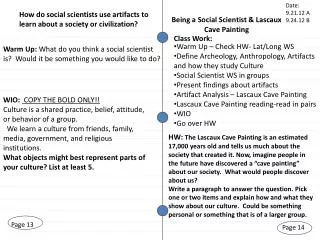
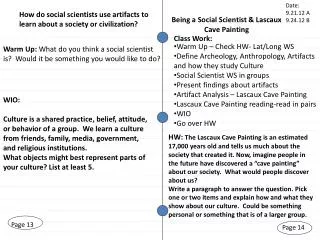
Date: 9.21.12 A 9.24.12 B How do social scientists use artifacts to learn about a society or civilization? Being a Social Scientist & Lascaux Cave Painting Class Work: • Warm Up – Check HW- Lat/Long WS • Define Archeology, Anthropology, Artifacts and how they study Culture • Social Scientist WS in groups • Present findings about artifacts • Artifact Analysis – Lascaux Cave Painting • Lascaux Cave Painting reading-read in pairs • WIO • Go over HW Warm Up: What do you think a social scientist is? Would it be something you would like to do? WIO: Culture is a shared practice, belief, attitude, or behavior of a group. We learn a culture from friends, family, media, government, and religious institutions. What objects might best represent parts of your culture? List at least 5. • HW: The Lascaux Cave Painting is an estimated 17,000 years old and tells us much about the society that created it. Now, imagine people in the future have discovered a “cave painting” about our society. What would people discover about us? • Write a paragraph to answer the question. Pick one or two items and explain how and what they show about our culture. Could be something personal or something that is of a larger group. Page 13 Page 14
Date: 9.25.12 A 9.26.12 B Why/How do historians use a common dating system to recognizing the beginning phases of human species? Understanding BC, BCE, AD, and CE Class Work: Warm Up: Make an educated guess. What do BC, AD, BCE, and CE stand for? Put the following dates in order of when they happened. A. Declaration of Independence – 1776 A.D. B. Columbus comes to the New World – 1492 A.D. C. Adena culture begins in Ohio - 800 B.C. D. Roman Republic is established – 509 B.C. • Warm Up – Check HW-Culture Paragraph-Share in pairs. • Notes- What is this BCE, CE, BC, and AD? • Timeline Activity • WIO • Discovery Video Clip • Go over HW WIO: Answer in complete sentences: What did you think of the timeline activity? Did it help you understand the differences between BC, BCE, AD and CE better? Explain. • HW: • Read over Hominid Chart. • Using the Hominid Chart, put the various hominids in chronologic order, on the timeline, according to when they came into being. Page 15 Page 16
Date: 9.26.12 A 9.26.12 B What are the significant characteristics about various types of hominids? Caveman Catastrophe Class Work: Warm Up: Use your hominid chart to answer the following questions. Which hominid do the following statements describe? I walk on two feet, am about 5 feet tall, and I was the first hominid to make fires. I am from Europe and central to southwestern Asia, and I was the first early human to have a language. • Warm Up – Check HW- Hominid Timeline • Pass back quizzes and maps • Watch “Caveman Catastrophe” • Pair/Share video questions • WIO • HW—Return Progress Report with parent signature WIO: 3-2-1 about hominids 3 – Write 3 things you have learned about hominids 2- Write 2 facts you thought were really interesting (these need to be different than the 3 things you learned) 1- Write 1 question you still have about early humans. • HW: • Redo Imagination Nation Map, if necessary • Return Progress Report with Parent Signature!!! Page 17 Page 18