Understanding Persistent Pain in Older Adults: Impacts on Mobility and Fall Risk in Assisted Living
This study explores the prevalence and implications of persistent pain among older adults in assisted living facilities (ALFs). With a sample of 156 residents, it reveals that 59% experience persistent pain, significantly affecting their mobility and daily activities. The pain group was more reliant on assistance and had a higher incidence of falls, although not statistically significant. The research aims to understand the interplay between pain management and mobility assistance, paving the way for better care practices in ALFs. Future work will focus on the effects of analgesic orders and fall rates over time.

Understanding Persistent Pain in Older Adults: Impacts on Mobility and Fall Risk in Assisted Living
E N D
Presentation Transcript
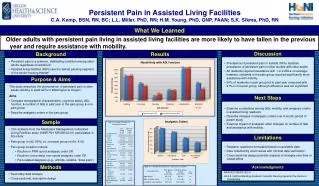
Persistent Pain in Assisted Living Facilities C.A. Kemp, BSN, RN, BC; L.L. Miller, PhD, RN; H.M. Young, PhD, GNP, FAAN; S.K. Sikma, PhD, RN What We Learned Older adults with persistent pain living in assisted living facilities are more likely to have fallen in the previous year and require assistance with mobility. Background Results Discussion • Persistent pain is a common, debilitating condition among older adults regardless of residence1 • Assisted living facilities (ALFs) are the fastest growing segment of the senior housing market2 • Prevalence of persistent pain in sample (59%) matches prevalence of persistent pain in other studies with older adults • All residents required assistance with 1 to 2 ADLs on average; however, residents in the pain group required significantly more assistance with mobility • 50% of residents in pain group fell in past year compared with 41% in non-pain group, although difference was not significant Purpose & Aims • This study describes the phenomenon of persistent pain in older adults residing in eight ALFs in Washington & Oregon • Aims • Compare demographic characteristics, cognitive status, ADL function, & number of falls in past year in the pain group & non-pain group • Describe analgesic orders of the pain group Next Steps • Examine correlations among falls, mobility, and analgesic orders in assisted living residents • Describe changes in analgesic orders over 6-month period of parent study • Examine impact of analgesic order changes on number of falls and assistance with mobility Sample • 156 residents from the Medication Management in Assisted Living Facilities study (NINR R21 NR009102-01) participated in this study • Pain group (n=92, 59%) vs. non-pain group (n=64, 41%) • Pain group inclusion criteria: • Routine or PRN opioid analgesic order OR • Routine (>once daily) non-opioid analgesic order OR • Pain-related diagnosis (e.g., arthritis, sciatica, “knee pain”) Limitations • Research questions formulated based on available data • Data collected by chart review with minimal data verification • Cross-sectional design prohibits analysis of changes over time or causal effect Methods Acknowledgments • Secondary data analysis • Cross-sectional, descriptive design NINR R21 NR009102-01 John A. Hartford Building Academic Geriatric Nursing Capacity Pre-Doctoral Scholarship