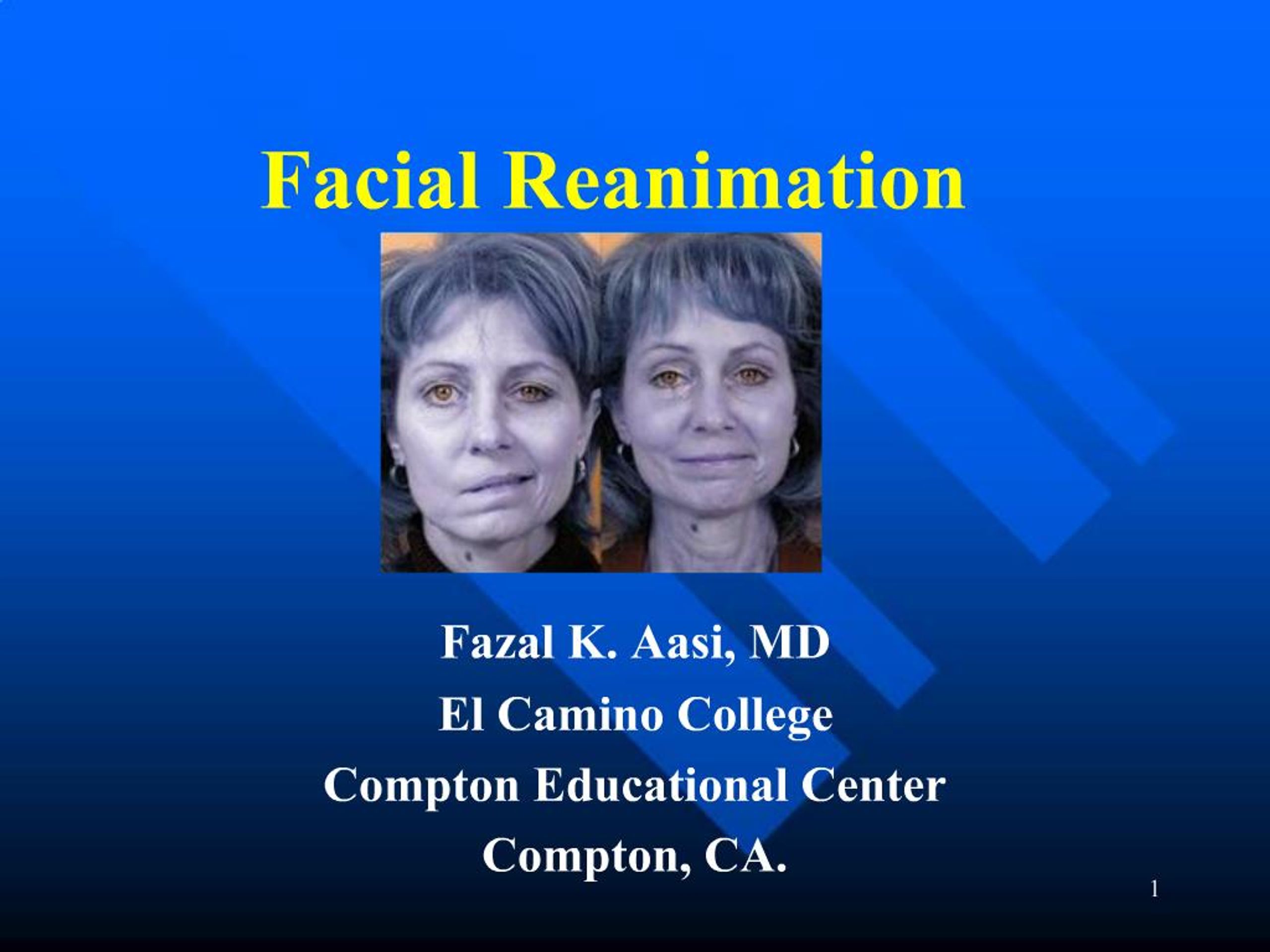
1. Facial Reanimation Fazal K. Aasi, MD
El Camino College
Compton Educational Center
Compton, CA. 1
2. Facial Reanimation 2 Facial reanimation is a family of different surgical techniques to make one's paralyzed face move more normally.
3. Anatomy of Facial Nerve 3
4. Anatomy of Facial Nerve The pathway of the facial nerve is long and relatively convoluted.
So there are a number of causes that may result in facial nerve paralysis 4
5. Causes of Facial Paralysis Bell’s palsy
Stroke
Transient Ischemic Attack
Herpes virus infections
Neurofibroma of the 8th cranial nerve.
Accidents and injuries.
Mobius syndrome, characterized by underdeveloped facial nerves.
5
6. �Iatrogenic Injuries� Parotidectomy
Excision of Acoustic Neuromas
Facial nerve decompression for Bell’s palsy 6
7. Complications of Facial Paralysis Facial paralysis severely hinders:
Normal facial expressions
Mastication
Speech production
Eye protection. 7
8. Psychological Trauma
The most significant complication is the social isolation these patients often succumb to.
8
9. Reanimation Techniques Are based on:
The cause of the facial paralysis
Type of injury and its location
The duration of deficit.
9
10. Facial Reanimation Techniques Broadly classified into:
Neural methods:
Micro-neurological surgery to re-suture the damaged nerve.
Nerve graft.
Nerve substitution 10
11. Facial Reanimation Techniques Musculofascial transpositions:
Move new muscles and nerves into the face to take the place of the injured facial nerve.
Facial plastic procedures.
Prosthetics.
11
12. 12 Micro-neurological Surgery Facial nerve repair is the most effective procedure to restore facial function in patients who have suffered nerve damage from an accident or during surgery.
It involves microscopic repair of a nerve that has been cut.
A nerve graft replaces one that has been removed.
13. 13 Nerve Substitution Is indicated when the nerve cannot be repaired in the conventional manner.
In this procedure, another cranial nerve involved in facial movement is connected to the damaged nerve and takes over its function.
14. Nerve Transposition Nerve transposition is also known as facial-hypoglossal transfer.
Restores movement to the side of the face that has been paralyzed.
With the stump of the 12th nerve hooked up to the end of the 7th nerve, the face will move when the tongue is moved.
14
15. Hypoglossal Facial Nerve Transfer Entire hypoglossal nerve transected 40% segment of nerve secured to
lower division. 15
16. Hypoglossal Facial Nerve Transfer Jump graft modification Reflection of the facial nerve out of the mastoid bone. 16
17. 17 �Temporalis Transfer� Involves taking a 1-2 cm band of the temporalis muscle.
Rotating it from the temple region, over the cheek bone and down, to attach to the corner of the mouth.
When it is appropriately secured, the act of biting down will result in elevation of the corner of the mouth toward the cheekbone, just as in smiling.
18. Temporalis Muscle Transfer 18
19. 19 Temporalis Transfer
20. Digastric Muscle Transposition 20
21. 21 Gracilis Graft For Facial Paralysis
22. 22 Combination Muscle And Nerve Graft In a combination muscle and nerve graft, two procedures are performed several months apart.
Free muscle tissue is grafted from the leg to the face following a cross-facial nerve graft.
The nerve graft becomes the nerve supply for the healthy, transplanted muscle.
23. 23 Facial Nerve Decompression Performed in severe cases when the facial nerve is seriously deteriorating.
Patients are at risk for permanent paralysis and have a poor prognosis without aggressive intervention.
Research has shown that this procedure is effective in improving outcomes in a select group of patients.
To be effective, the surgery must be performed within 2 weeks of the onset of symptoms.
24. Facial Nerve Decompression 24
25. Rehabilitation of the Paralyzed Eye Is accomplished by one of several techniques
The eyebrow can be repositioned by performing a unilateral brow lift, and matching the brow height with the other side.
The eyelids can be addressed using implantable eyelid springs so that gravity assists with eye closure.
Using lid gold weights
Canthoplasty
25
26. Lid Gold Weights. 26
27. 27 �The Nose� The collapse of the nasal sidewall can be corrected either from the outside or the inside of the nose.
Outside techniques involve placing strips of suspension material from the cheekbone, under the skin, to the nasal sidewall, and suspending the nasal sidewall in its anatomic position.
To widen the nasal cavity from the inside, small cartilage grafts can be inserted into the framework of the nose.
28. �Nasal wall Suspension� 28
29. 29 Static Facial Suspension Static Facial Suspension is used to lift the corner of the mouth so that balance is restored to the face and drooling out of the mouth is helped.
30. 30 Cosmetic Surgeries Cosmetic surgeries such as:
Brow-lifts
Face-lifts
Muscle shortening
Removal of excess upper eyelid skin
Muscle relaxing procedures
Static slings
Improve appearance, but will not improve muscle function.��
31. Miniature Micro Chip Technology and Artificial Muscle Implant 31
32. 32