Download
1 / 14
140 likes | 288 Vues
The Peripheral Nervous System (PNS) consists of 12 pairs of cranial nerves and 31 pairs of spinal nerves. It includes sensory (afferent), motor (efferent), and mixed nerves that transmit signals between the Central Nervous System (CNS) and the body. Spinal nerves emerge from the spinal cord and are vital for reflex actions. Reflex arcs facilitate quick, involuntary responses and can be monosynaptic (one synapse) or polysynaptic (multiple synapses). Understanding these components helps clarify the PNS's crucial role in body coordination and response.

E N D
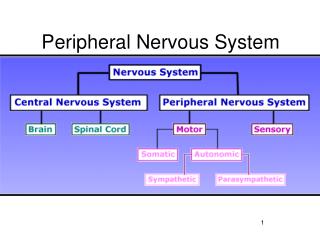
PNS • Cranial nerves (12 pairs) • Spinal Nerves (31 pairs)
Ganglia • Group of cell bodies in PNS.
SENSORY • Towards CNS, Afferent nerve. • (From receptors towards brain/spine)
MOTOR • AWAY FROM CNS, efferent nerve • From brain/spine to effectors (muscles)
MIXED • Sensory and motor neurons.
SPINAL NERVES • 31 pairs. All mixed out of spinal cord, branches come out through holes in vertebrate.
SPINAL NERVES • COLOR CODE Cross section a-j.
Page 238 • A. Spine • B. Gray Matter • C. White Matter • D. Spinal Nerve • E. Dorsal Root • G. Dorsal Root ganglion • J. Ventral Root.
REFLEX ARC • Response between PNS and spinal cord • Quick, involuntary response
MONOSYNAPTIC • One synapse • 2 nerves = 1 sensory + 1 motor
Multisyanptic • MANY SYNAPSES • Multiple neurons