
Optimizing Hardware Allocation with Simulated Annealing Techniques
E N D
Presentation Transcript
Simulated-Annealing-Based Solution By Gonzalo Zea s031418 Shih-Fu Liu s031003
Agenda • Hardware Allocation Problem • Input Description • Basic Allocation Problem • Subproblem • Formulation of the entire data path synthesis problem • Cost Table • Conditional Resource Sharing • Simulated-Annealing-Based Solution • Generating New States • Stopping criteria • Cost function • Constraints • Delays • Loops • Result of example • Synthesizing Pipelined Data Paths • Conclusions – Agenda – Hardware Allocation Problem Simulated-Annealing-Based Solution
Hardware Allocation Problem • execution speed of the data path (T) • total hardware cost of the data path (C) • f(T,C) should be minimized Agenda – Hardware Allocation Problem – Simulated-Annealing-Based Solution Simulated-Annealing-Based Solution
Input Description • Code sequence where parallelism, sequentiality, and disjointness (mutually exclusive operations) are explicitly stated • Compilerlike optimization techniques (e.g. dead code elimination, constant folding) • Disjointness is a result of the conditional clauses in the input description Agenda – Hardware Allocation Problem – Simulated-Annealing-Based Solution Simulated-Annealing-Based Solution
Basic Allocation Problem • given description allocate into a minimum number of registers • Arithmetic unit allocation • entails scheduling operations • minimum numbers of ALU’s • meeting cost or timing constraints Agenda – Hardware Allocation Problem – Simulated-Annealing-Based Solution Simulated-Annealing-Based Solution
Subproblem • Abolish fixed code sequence gaining an extra degree of freedom • Disjoint variables share the same register • Precedence constraints must be met Agenda – Hardware Allocation Problem – Simulated-Annealing-Based Solution Simulated-Annealing-Based Solution
Formulation of the entire data path synthesis problem • C = p1 * (#alu) + p2 * (exec_time) + p3 * (#register) + p4 * (#bus) • p1, p3, p4 … area parameters • p2 … execution time parameter • By meeting constraints and being minimal, C is optimal Agenda – Hardware Allocation Problem – Simulated-Annealing-Based Solution Simulated-Annealing-Based Solution
Cost Table • Register cost • Equal to the area of the library register cost • Costs of ALU operations • non linear function • Estimating interconnecting area • Complex function of the number of registers and ALU’s in the data path Agenda – Hardware Allocation Problem – Simulated-Annealing-Based Solution Simulated-Annealing-Based Solution
Conditional Resource Sharing • Disjoint statements can exist on top of each other on the same time-space slot resource sharing Agenda – Hardware Allocation Problem – Simulated-Annealing-Based Solution Simulated-Annealing-Based Solution
Simulated-Annealing-Based Solution Hardware Allocation Problem – Simulated-Annealing-Based Solution – Loops Simulated-Annealing-Based Solution
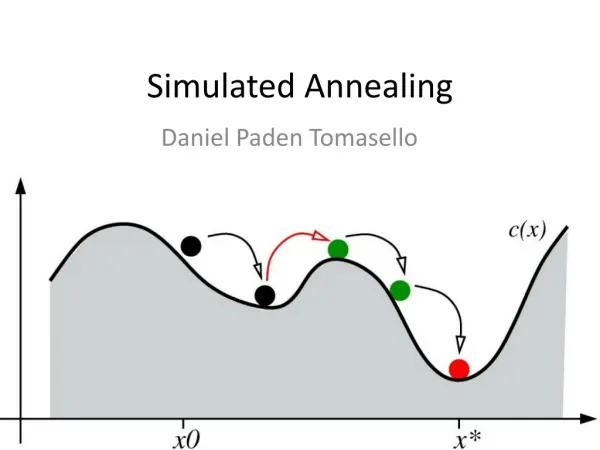
Simulated-Annealing-Based Solution • Basic algorithm • Random generation of new states Hardware Allocation Problem – Simulated-Annealing-Based Solution – Loops Simulated-Annealing-Based Solution
Simulated-Annealing-Based Solution • Acceptance rule of the generated states depending on the temperature T Hardware Allocation Problem – Simulated-Annealing-Based Solution – Loops Simulated-Annealing-Based Solution
Simulated-Annealing-Based Solution • Number of states generated influences quality and can be defined by user Hardware Allocation Problem – Simulated-Annealing-Based Solution – Loops Simulated-Annealing-Based Solution
Simulated-Annealing-Based Solution Hardware Allocation Problem – Simulated-Annealing-Based Solution – Loops • Most important points • Generation of new states • Optimization of the cost function Simulated-Annealing-Based Solution
Generating New States • Interchanging two code operations • Displacing a code operation from one location to another • Interchanging variables in a symmetric operation Hardware Allocation Problem – Simulated-Annealing-Based Solution – Loops Simulated-Annealing-Based Solution
Generating New States cont’d • High Temperature • Two numbers (a, b) randomly generated • If (b < number of operations) • Interchanging two operations • Violate constraints variables are interchanged • If (b > number of operations) • New random location is generated • If not violate constraints Hardware Allocation Problem – Simulated-Annealing-Based Solution – Loops Simulated-Annealing-Based Solution
Generating New States cont’d • Low Temperature • Two numbers (a, b) randomly generated • If (b < number of operations) • Interchanging neighboring operations • Violate constraints variables are interchanged • If (b > number of operations) • Displacement with neighboring operations in time or space slots in random order Hardware Allocation Problem – Simulated-Annealing-Based Solution – Loops Simulated-Annealing-Based Solution
Stopping Criteria • Cost function stays the same for three temperature points. Hardware Allocation Problem – Simulated-Annealing-Based Solution – Loops Simulated-Annealing-Based Solution
Cost function • Depends on • Number of registers • Interconnection costs • Links • Buses Hardware Allocation Problem – Simulated-Annealing-Based Solution – Loops Simulated-Annealing-Based Solution
Constraints • Hardware Resource • Number of ALU’s & Registers • Execution Time Hardware Allocation Problem – Simulated-Annealing-Based Solution – Loops Simulated-Annealing-Based Solution
Delays • Highest common factor of all different operation delays equals one time frame • Interchanges or displacements of operations affects the time position Simulated-Annealing-Based Solution – Loops – Synthesizing Pipelined Data Paths Simulated-Annealing-Based Solution
Loops space • Unwinding depends on disjointness • Improving of execution time Simulated-Annealing-Based Solution – Loops – Synthesizing Pipelined Data Paths time Simulated-Annealing-Based Solution
Results of Examples • HAL • Clock cycles : 17 • Multipliers : 3 • Adder : 3 Simulated-Annealing-Based Solution – Loops – Synthesizing Pipelined Data Paths • SAB-Solution • Clock cycles : 17 • Multipliers : 2 • Adder : 3 • Calculation time increases quadratically Simulated-Annealing-Based Solution
Synthesizing Pipelined Data Paths • Pipelining • Inserting registers between logic modules • Increasing latency • Improving throughput • Pipeline Synthesis • Partitioning input data flow description into pipeline stages • Finding a placement of micro-operations within each stage for meeting constraints Loops – Pipelined Data Paths - Conclusion Simulated-Annealing-Based Solution
Synthesizing Pipelined Data Paths • Algorithm • Serial pipeline schedule • Doesn’t violate delay constraints • If max. delay exceeded separating into a new stage • Each stage placement problem is treated separately and afterwards summed up Loops – Pipelined Data Paths - Conclusion Simulated-Annealing-Based Solution
Synthesizing Pipelined Data Paths • Algorithm • Interchanging and displacement • Moving operations within adjacent stages • Constraint violation allowed with penalization • Doesn’t appear in the final result • Displacing last phase operations to the empty stages Loops – Pipelined Data Paths - Conclusion Simulated-Annealing-Based Solution
Synthesizing Pipelined Data Paths • Algorithm • Throughput • k … number of stages • di … delay of each stage • ρ … expected resynchronization rate Loops – Pipelined Data Paths - Conclusion Simulated-Annealing-Based Solution
Conclusion • Entire allocation process two-dimensional placement problem • Simultaneously cost-constrained allocation of hw resources and execution time • Trade-off hardware cost against execution speed Pipelined Data Paths – Conclusion - Simulated-Annealing-Based Solution
Simulated-Annealing-Based Solution By Gonzalo Zea s031418 Shih-Fu Liu s031003