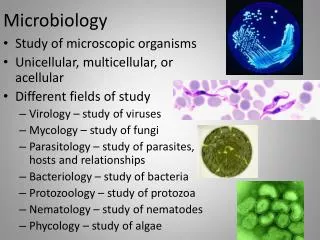
Microbiology
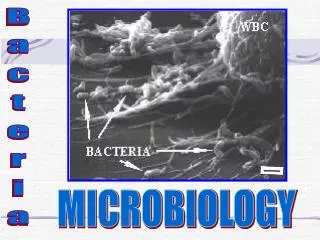
Bacteria are prokaryotic organisms, the smallest living entities, thriving in diverse environments including soil, water, and even extreme conditions like Arctic ice and hot springs. They are classified into three shapes: cocci (spherical), bacilli (rod-shaped), and spirilla (spiral). Bacterial infections can lead to various diseases such as leprosy, tuberculosis, and strep throat, often spread by vectors like rats and mosquitoes that do not catch the illness themselves. Researchers study microbial pathogens using advanced methods including computer modeling and clinical trials to better understand these microscopic entities.


Microbiology
E N D
Presentation Transcript
Bacteria • Bacteria are… • … prokaryotic organisms ( the smallest living thing) • Where do they live? • Soil, Radioactive waste, Water, Plants, Humans, Deep in the earth's crust, Arctic ice, Glaciers, Hot springs, The stratosphere (between 6 to 30 miles up in the atmosphere), Ocean depths
Classifying Bacteria • How do we classify bacteria? • By 3 different shapes • Spherical Usually the simplest ones. These bacteria are called cocci (singular coccus). • Rod shaped These are known as bacilli (singular bacillus). • SpiralThese are known as spirilla(singular spirillus).
Diseases CAUSED BY BACTERIA • Common bacterial diseases • leprosy, tetanus, syphilis, typhoid fever, strep throat, tuberculosis, salmonella, whooping cough
VEctors • What is a vector? • Animal disease spreaders that don’t catch the illness • They carry infectious disease (can be passed from one generation to the next) • Examples… • Rats, ticks, and mosquitoes
Studying disease • What do scientists study? • Microbial pathogens – disease causing agents • Examples? • Virus, Bacteria, Parasite
Studying Disease • How do they study pathogens? • Computer modeling, cell cultures, animals, clinical trials