Download
1 / 55
550 likes | 661 Vues
Explore the historical development of the periodic table, starting with Antoine Lavoisier's initial list of 23 elements to the growing recognition of 70 elements by the 1870s. Discover Dobereiner's triads, Newlands' Law of Octaves, and Mendeleev's innovative organization of elements by increasing atomic mass. Mendeleev’s system not only arranged elements according to properties but also anticipated undiscovered elements through gaps in his table. This overview highlights the evolution of chemical organization that led to the modern periodic table.

E N D
The Periodic Table Chap. 6
Early Attempts at Organizing the Elements • Lavoisier’s list: 23 elements
Early Attempts at Organizing the Elements • Lavoisier’s list: 23 elements • 1870’s : 70 known elements
Early Attempts at Organizing the Elements • Lavoisier’s list: 23 elements • 1870’s : 70 known elements • Dobereiner’s triads
Halogen Triad Cl Br I mass 35.5 u 79.9 u 127 u .00321 3.12 4.93 density -101oC -7oC 114oC M.P. -34 oC 59oC 185oC B.P.
Self Check – Ex. 1 Ca Sr Ba mass 40 u 88 u 137 u 1.55 ? 3.62 density 842oC ? 727oC M.P. 1500oC 1412oC 1845 oC B.P.
Self Check – Ex. 1 Ca Sr Ba mass 40 u 88 u 137 u 1.55 2.6 3.62 density 842oC 7770C 727oC M.P. 1500oC 1412oC 1845 oC B.P.
Early Attempts at Organizing the Elements • Lavoisier’s list: 23 elements • 1870’s : 70 known elements • Dobereiner’s triads • Newlands: Law of Octaves
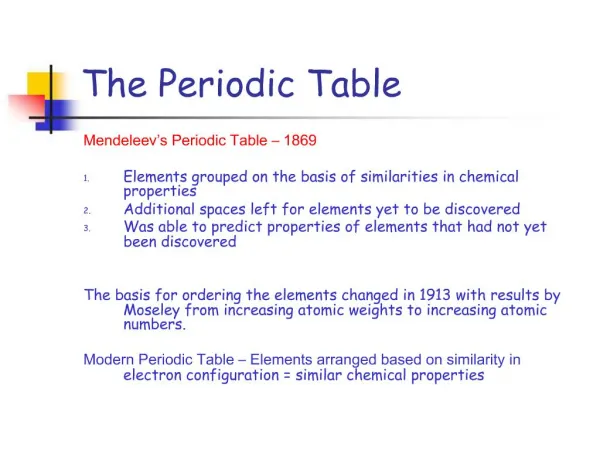
Early Attempts at Organizing the Elements • Mendeleev’s Table
Early Attempts at Organizing the Elements • Mendeleev’s Table • produced simultaneously with Meyer
Early Attempts at Organizing the Elements • Mendeleev’s Table • produced simultaneously with Meyer • organized elements by increasing mass
Early Attempts at Organizing the Elements • Mendeleev’s Table • rearranged a few elements to match properties
Early Attempts at Organizing the Elements • Mendeleev’s Table • rearranged a few elements to match properties • left gaps for undiscovered elements
Early Attempts at Organizing the Elements • Mendeleev’s Table • rearranged a few elements to match properties • left gaps for undiscovered elements • described periodic law
Periodic Law When arranged according to increasing atomic number, there is a repeating pattern of an element’s properties
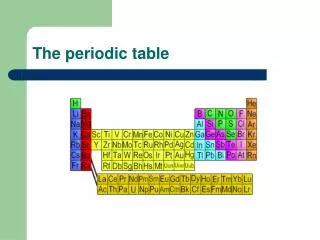
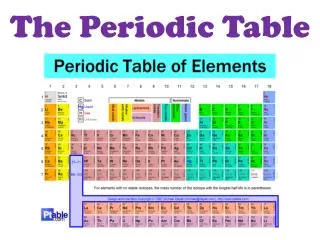
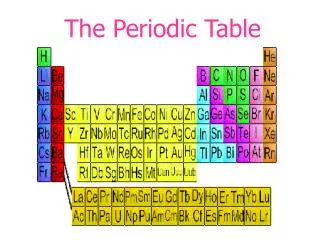
The Modern Periodic Table • Periods
The Modern Periodic Table • Periods • Groups/Families
The Modern Periodic Table • Periods • Groups/Families • Metals/Non-Metals/Semimetals
The Modern Periodic Table • Periods • Groups/Families • Metals/Non-Metals/Semimetals • Transition Metals/Inner Transition Metals/ Representative Elements
The Modern Periodic Table • Periods • Groups/Families • Metals/Non-Metals/Semimetals • Transition Metals/Inner Transition Metals/ Representative Elements • Physical States
The Modern Periodic Table • Periods • Groups/Families • Metals/Non-Metals/Semimetals • Transition Metals/Inner Transition Metals/ Representative Elements • Physical States • Naturally occurring elements
Periodic Trends • Valence Electrons
Periodic Trends • Valence Electrons • as you go down a group, the number of valence electrons __________
Periodic Trends • Valence Electrons • as you go down a group, the number of valence electrons __________ • as you go across a period, the number of valence electrons __________
Periodic Trends • Atomic Radius
Atomic radius Distance between the nucleus and the outermost electron.
Periodic Trends • Atomic Radius • as you go down a group, the atomic radius __________
Periodic Trends • Atomic Radius • as you go down a group, the atomic radius __________ • as you go across a period, the atomic radius __________
Self Check – Ex. 2 Put the following atoms in order from smallest to largest radius P Mg O Ca
Periodic Trends • Ionic Radius
Ion An atom that has gained or lost an electron
Periodic Trends • Ionic Radius • as you remove an electron, the radius __________
Periodic Trends • Ionic Radius • as you remove an electron, the radius __________ • as you add an electron, the radius __________
Periodic Trends • Ionic Radius • as you remove an electron, the radius __________ • as you add an electron, the radius __________ • the isoelectronic atoms that are the smallest have the most _______
Isoelectronic atoms Atoms that have the same number of electrons.
Self Check – Ex. 3 Put the following in order of increasing radius Cl- Ca2+ Ar K+
Periodic Trends • 1st Ionization Energy
Ionization Energy The energy required to remove an electron.
Periodic Trends • 1st Ionization Energy • as you go down a group the ionization energy ________
Periodic Trends • 1st Ionization Energy • as you go down a group the ionization energy ________ • as you go across a period the ionization energy ________
Periodic Trends • 1st Ionization Energy • as you go down a group the ionization energy ________ • as you go across a period the ionization energy ________ • as you remove each additional electron the ionization energy ________
Self Check – Ex. 4 For what ionization will a large jump in ionization energy be observed with aluminum?
Periodic Trends • Electronegativity
Electronegativity The ability of an atom to attract electrons in a chemical bond.