

SlideServe
Menu
Préférences
© SlideServe · v2026

Unit 4

haroun avatar
13 diapositives · 362 Views · Sep 06, 2014

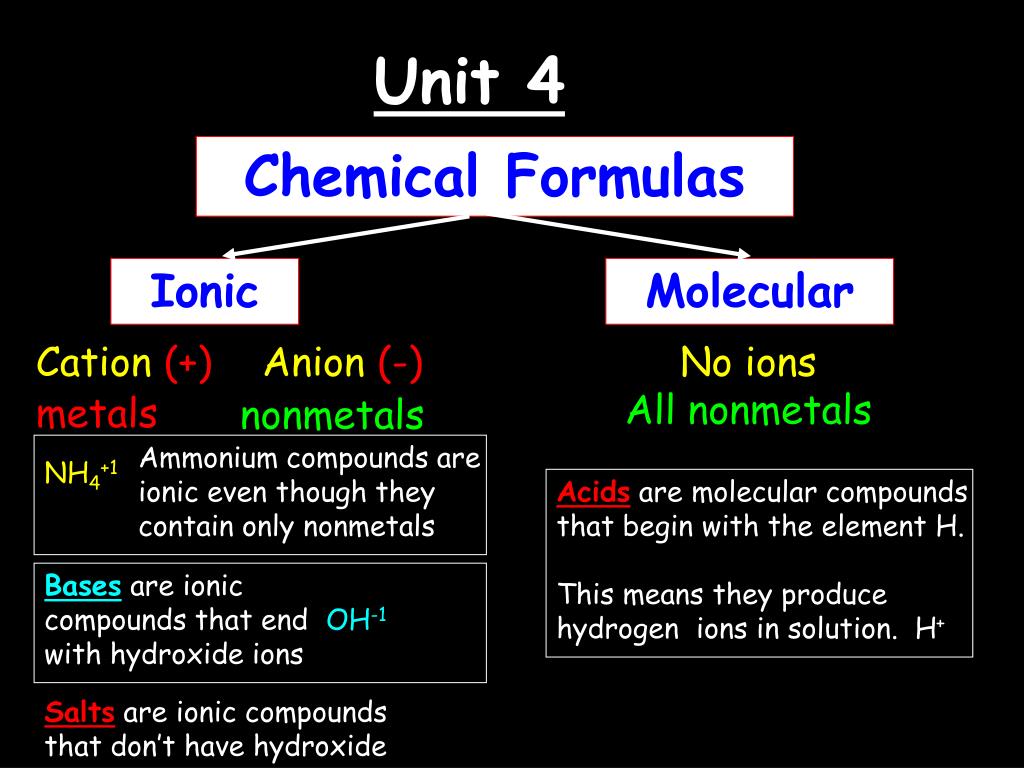
Unit 4. Chemical Formulas. Ionic. Molecular. Cation. (+). Anion. (-). No ions All nonmetals. metals. nonmetals. Ammonium compounds are ionic even though they contain only nonmetals. NH 4 +1. Acids are molecular compounds that begin with the element H.
Unit 4 - slide 1
01 / 13Unit 4
1 / 17

Télécharger la présentation

Unit 4
Une image / un lien ci-dessous est fourni (tel quel) pour télécharger la présentation

Politique de téléchargement : le contenu du site vous est fourni TEL QUEL pour votre information et votre usage personnel ; il ne peut être vendu, concédé sous licence ni partagé sur d’autres sites sans l’accord de son auteur.Le contenu vous est fourni TEL QUEL, pour votre information et votre usage personnel uniquement. Téléchargez la présentation en cliquant sur ce lien. Lors du téléchargement, si vous ne parvenez pas à télécharger une présentation, l’éditeur a peut-être supprimé le fichier de son serveur.Pendant le téléchargement, si vous ne parvenez pas à obtenir une présentation, le fichier a peut-être été supprimé par l’éditeur.

F I N

Plus de contenu associé

Transcription de la présentation
  1. Unit 4 Chemical Formulas Ionic Molecular Cation (+) Anion (-) No ions All nonmetals metals nonmetals Ammonium compounds are ionic even though they contain only nonmetals NH4+1 Acids are molecular compounds that begin with the element H. This means they produce hydrogen ions in solution. H+ Bases are ionic compounds that end with hydroxide ions OH-1 Salts are ionic compounds that don’t have hydroxide

  2. Nonmetals Metals Location of metals and nonmetals Note: Hydrogen is a nonmetal Metalloids

  3. Hydrogen is a nonmetal Acidsstart with “H” Ionic compounds start with metals or ammonium, NH4+ . Bases have OH- anions (Acid) HCl NaNO3 molecular ionic (salt) ionic CaCO3 CO2 (salt) molecular FeCl3 O2 ionic (salt) molecular H3PO4 Mg(OH)2 molecular (Acid) ionic (base)

  4. Hydrogen is a nonmetal Acidsstart with “H” Ionic compounds start with metals or ammonium, NH4+ . Bases have OH- anions ionic (salt) NH4Cl SO2 molecular HNO3 NaCl (acid) molecular ionic (salt) KOH NO2 ionic (base) molecular

  5. NAMING Chemical Formulas Ionic Molecular Cation (+) Anion (-) Monatomic anion ends in “ide” Transition metals with multiple charge use Roman numerals. (Reference sheet) CaCl2 calcium chloride CuCl2 copper (II) chloride Polyatomic ions (Use Reference sheet) KMnO4 potassium permanganate

  6. Polyatomic ions Reference: ammonium, NH4+1 hydroxide, OH- nitrate, NO3-1 carbonate, CO32- -2 chloride LiCl KNO3 lithium potassium nitrate MgCO3 Na2O magnesium carbonate sodium oxide +6 -6 Fe3+ -2(3) Fe2O3 FeO Iron (III) oxide Iron (II) oxide NH4NO3 Mg(OH)2 ammonium nitrate magnesium hydroxide

  7. Polyatomic ions Reference: ammonium, NH4+1 hydrogen carbonate, HCO31- (bicarbonate) dichromate, Cr2O72- sulfite, SO32- sulfate, SO42- phosphate, PO43- chloride NH4Cl CaCr2O7 ammonium calcium dichromate sodium hydrogen carbonate NaHCO3 Ca3(PO4)2 sodium bicarbonate calcium phosphate Na2SO4 CaSO3 sodium sulfate calcium sulfite

  8. NAMING Chemical Formulas Ionic Molecular Cation (+) Anion (-) All nonmetals Use prefixes Use periodic table and (Reference sheet) carbon monoxide CO carbon dioxide CO2 carbon tetrachloride CCl4 dinitrogen monoxide N2O

  9. Naming Binary Molecular Compounds • -Compounds between two nonmetals • -First element in the formula is named first. • -Second element is named as if it were an anion. • - Use prefixes • - Only use mono on second element - CO = carbon monoxide CO2 = carbon dioxide CCl4 = carbon tetrachloride N2O = dinitrogen monoxide

  10. dioxide SO2 sulfur tetraoxide N2O4 dinitrogen dioxide NO2 nitrogen P2O5 pentaoxide diphosphorus phosphorus trichloride PCl3 phosphorus pentachloride PCl5 octafluoride SF8 sulfur tetrafluoride XeF4 xenon monoxide NO nitrogen difluoride OF2 oxygen trichloride AsCl3 arsenic triiodide NI3 nitrogen

  11. Molecular Formulas(Acid Naming) • Acids without oxygen:General formula HA where A = “anion” Hydro_______ic acid HF = Hydrofluoric acid HCl = Hydrochloric acid HBr = Hydrobromic acid HI = Hydroiodic acid HCN = Hydrocyanic acid CN- = cyanide anion

  12. Naming AcidsH+ + (anions with oxygen) • Acids with oxygen: “ate-ic ite-ous” Anion nameAcid name ____ate ____ic acid ___ite ___ous acid HNO3 = Nitr__?__ acid Anion NO3-1 = nitrate Nitric acid HNO2 = Nitr__?__ acid Anion NO2-1 = nitrite Nitrous acid

  13. Naming AcidsH+ + (anions with oxygen) H2SO4 Formula H+ with AnionAcid name 2H+ + SO42- = sulfate Sulfuric acid H2SO3 2H+ + SO32- = sulfite Sulfurous acid HC2H3O2 H+ + C2H3O2-1 = Acetate Acetic acid H3PO4 3H+ + PO43- = Phosphate Phosphoric acid HClO4 H+ + ClO41- = Perchlorate Perchloric acid H2CO3 2H+ + CO32- = Carbonate Carbonic acid