Download
1 / 2
20 likes | 131 Vues
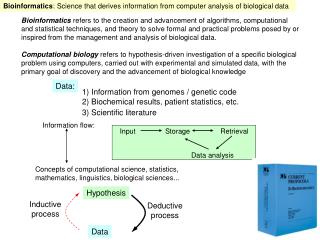
This course delves into the multifaceted nature of biological data and its analysis to uncover groundbreaking discoveries. Participants will gain insights into the complexities of data acquisition, experimental design, and the nuances of data curation, including the potential for errors. Attendees will explore methodologies for representing and classifying data, identifying relationships, and recognizing redundancy. Key topics include macromolecular structure, sequence-structure-function relationships, and cutting-edge algorithms. The course also highlights emerging themes in disorder, protein-protein interactions, drug discovery, and evolutionary biology.

E N D
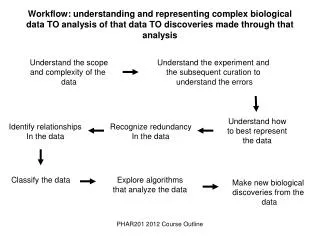
Workflow: understanding and representing complex biological data TO analysis of that data TO discoveries made through that analysis Understand the scope and complexity of the data Understand the experiment and the subsequent curation to understand the errors Understand how to best represent the data Identify relationships In the data Recognize redundancy In the data Classify the data Explore algorithms that analyze the data Make new biological discoveries from the data PHAR201 2012 Course Outline
But What Does it Mean Pragmatically? • Details of macromolecular structure • Consider the experiments used to derive structure • Ontologies • Sequence-structure-function relationships • Structure classification • Algorithms to compare structures • Algorithms to define domains • Hot topics: Disorder • Hot topics: Structure-based PPIs • Hot topics: Drug discovery through structure and systems biology • Hot topics: Evolution studied through structure PHAR201 2012 Course Outline