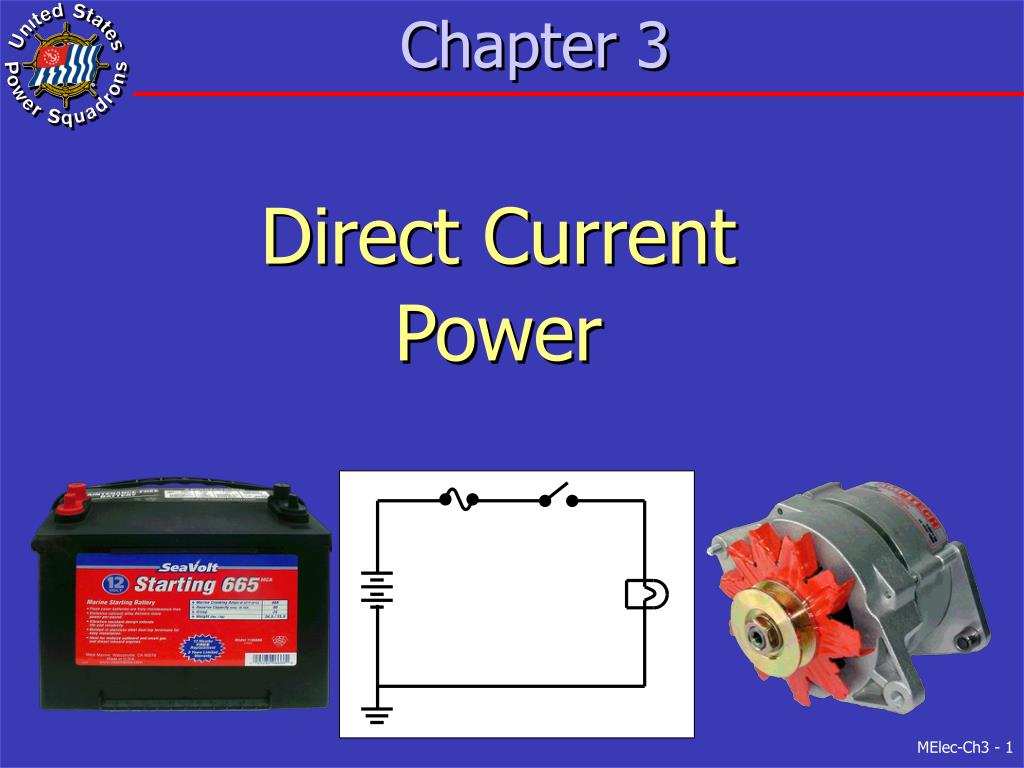
Chapter 3 Direct Current Power
Overview • Batteries • Safety Precautions • Marine Storage Battery • Charging Systems • Battery Utilization
Batteries • Cells and Battery • Battery Chemistry • Primary Cells • Secondary Cells • Series and Parallel Connections
Cells and Batteries • Cells generates DC by chemical reaction • Two dissimilar electrodes(conductors) • Immersed in electrolyte(current carrying solution) • Voltage function of electrode material • Difference on the Galvanic Scale • Covered in Chapter 5 • Battery • Group of cells connected together • Classes – Primary and Secondary
Primary Cells • Primary cells can not be recharged • Chemical process is not reversible • aka “Dry Cell” • Common chemistries • Zinc-carbon • Alkaline (zinc and manganese oxide) • Use • Flashlights • Portable radios • Nominal voltage 1.5 VDC
Secondary Cells • Secondary Cells can be recharged • Reversible chemical reaction • aka “rechargable” • Common chemistries • Lead-acid (2.1 VDC) • Nickel-cadmium (1.2 VDC) • Nickel-metal hydride (1.2 VDC) • Use • Cars and Boats
Series and Parallel Connections + + 12 V @ 100 A 6 V @ 100 A 6 V @ 100 A - - - 24 V @ 50 A Series + + 12 V @ 50 A 12 V @ 100 A 12 V @ 50 A - - + + Common 12 V @ 100 A 12 V @ 50 A 12 V @ 50 A - - Parallel Dual Voltage
Safety Precautions • Lead-Acid batteries • May produce explosive gases • Contain acid • Battery acid & seawater produce Chlorine Gas • Charge batteries in well-ventilated area • Keep sparks, flames and cigarettes away • Wear eye, face and hand protection • Baking Soda is effective neutralizing solution
Warning Message
Marine Storage Batteries • Types • Technologies • Sizes • Marine Battery Ratings • Selection, Installation and Maintenance
Types • Starting battery • Large amount of current for very short time • Not fuse protected • Deep-Cycle battery • Power for many hours • Can be discharged to 50% capacity • Protected by large (200 to 400A) fuse • Dual-Purpose battery • Large plates (like starting) • Thick plates (like deep-cycle)
Technologies • Flooded • Sometimes called “flooded” or “free-vented” • Gelled Electrolyte (Gel) • Also called Valve-Regulated Lead Acid (VRLA) • Absorbed Glass Mat (AGM) • Also called Valve-Regulated Lead Acid (VRLA)
Flooded • Traditional marine battery • Electrolyte is water-diluted sulfuric acid • Electrodes are lead • Free vented – charging gases escape • Advantages • Low initial cost • Good deep-cycle performance • Disadvantages • Spillable electrolyte • High self-discharge rate
Gelled Electrolyte (Gel) • Gelled Electrolyte • Electrolyte is a gel • Mixture of sulfuric acid, fumed silica & phosphoric acid • Pressure-relief vents (charging gases can’t escape) • Advantages • Spillproof / leakproof (can be used in any orientation) • Lowest cost per cycle • Low self discharge rate • Disadvantages • High initial cost • Can be damaged, if charged at wet cell rate
Deep-Cycles Gel Battery
Absorbed Glass Mat (AGM) • Designed for military aircraft • Use matted glass fibers between plates • Advantages • Spillproof / leakproof (can be used in any orientation) • Most shock and vibration resistant • Disadvantages • Capable of fewer discharge cycles
Advantages / Disadvantages
Sizes
Battery Ratings • Ampere-hour (Ah) – Storage capacity • Open Circuit Voltage (V) – Battery at rest • Starting batteries • Cold Cranking Amps (CCA) – 30 sec at 0 F • Marine Cranking Amps (MCA) – 30 sec at 32 F • Reserve Capacity (RC) – minutes of 25 A at 80 F • Deep-cycle batteries • Rated Capacity – Amp-hours for 20 hr at 80 F • Deep Cycle Capacity • Ability to provide small amounts of current over time • Ability to withstand long, deep discharges
Battery Ratings by Battery Type
Selection, Installation and Service • Selection • DC Power Requirements • Typical 24-hour load • Installation • Maintenance (Service) • Water • Cleaning Terminals • Winter Lay-up
Selection • Starting Battery replacement • Same Group Size and MCA • Initial Cost or Life Cycle Cost? • Flooded – Less expensive to buy • House (Deep-cycle) Battery replacement • Consider increased capability • Double battery life if depth of discharge only 25% • Initial Cost or Life Cycle Cost? • Gel - Capable or more discharge cycles • Ratios (Battery size to largest expected load) • Flooded – 4 to 1 • Gel and AGM – 3 to 1
DC Power Requirements • What source of DC power? • Powerboat normally powered off an alternator • Sailboats normally powered off House Battery • If anchored – Generator or House Battery? • How often between battery charging? • Limit depth of discharge to 50% • For minimal charging time - Limit depth to 35% • Battery life cut in half, if discharge to 75% • Following table gives typical DC power demands
Typical 24-hour Load
Installation • Flooded batteries require • Vented battery compartment • Easy access to add water • All batteries • Should be in acid-resistant box • Secured with insulated cover • Starting battery located near engine • Don’t mix battery age in a battery bank • Don’t mix battery chemistry in battery bank
Maintenance (Service) • Flooded-cell require distilled water • Rapid loss in single cell indicates bad battery • Rapid loss in all cells indicates high charging voltage • Never force open or add water to Gel or AGM • Clean and tighten terminals twice a year • Use special battery tools (illustrated on next slide) • Can remove corrosion with Baking Soda solution • Don’t get solution into battery fill ports • Apply battery “grease” to terminals
Battery Tools • Dirty or loose battery terminals can materially reduce the energy available from a battery • Use proper battery tools to prevent damage to battery Battery Terminal Puller Battery Terminal Cleaner
Winter Lay-up • Fully charge and service before winter lay-up • Flooded batteries should be equalized • Disconnect negative battery terminal cable • Flooded deep-cycle should be charged every 50 days • Gel and AGM should be charged every 6 months • Also flooded starting • Continuous trickle charge not recommended • Unless have automatic cutoff
Charging Systems • Basic Considerations • Degree of Charge • Alternators • AC Battery Chargers • Inverter/Charger • Other
Basic Considerations • Charging requires more charge (in amp-hours) than removed • Flooded 115 to 120% • VRLA 105 to 114% • Phases • Bulk at 20 to 40% of battery's capacity • Continues until 75% full • Acceptance charging rate is steadily reduced • Continues until accepted current equals 2% capacity • Float current is only 0.1 to 0.2 Amps • Maintenance, not charging
Basic Considerations - 2 • Proper Charging Voltage depends on • Temperature (table on slide 33 based on 80 F) • Higher temperatures require lower voltage • Battery Chemistry • Table gives charging voltage by phase & chemistry • Flooded-cell Equalization • Prevents “sulfation” • Recommended every 20 to 50 cycles • Over charge, after acceptance phase, to dissolve lead sulfate crystals on battery’s plates • High voltage may damage electronic equipment
Degree of Charge • Flooded cell with hydrometer (most accurate) • Gel and AGM with volt meter • Can also use volt meter on flooded cell • Next slide gives voltages for rested batteries • Not charged or discharged for 24 hours • Can also bleed off surface charge • Use large light bulb for several minutes
Lead-acid 12 volt Voltages
Alternators • Alternator converts AC to DC with diodes • Don’t disconnect battery while alternator running • “Zap-Stop” ® will protect diodes from damage • Alternator sized at 25-40% of battery capacity • Charging Diodes (Isolators) • Permit charging of two batteries • Have approx 0.6 to 0.7 voltage drop • Increase alternator voltage for correct voltage at battery • Illustrated on next slide
Multiple Battery Charging Battery Isolators + + + Engine Driven Alternator - - - - #1 + Starting Battery House Battery AC Charger (Two-outputs) #2 + - Negative Common
AC Battery Chargers • Basic charger (not recommended) • Single output voltage • Can’t do bulk, acceptance, and float charging • Can’t handle multiple chemistries
AC Battery Chargers - 2 • SCR multi-stage (recommended) • Three phase charger (bulk, acceptance & float) • Also will do equalization • Independent multiple outputs • Independent setting for Flooded, Gel and AGM • Independent as to phase • Best for Deep-Cycle 2 outputs @ 10 A temperate climate 3 outputs @ 40 A cold, warm or hot climates
Inverters / Chargers • Charger converts 120 VAC to DC • Inverter converts 12 VDC to 120 VAC • More on inverters in Chapter 4 on AC • Advantages • Lighter & cheaper than separate systems 2Kw inverter 100A charger 3-stage multiple batteries
Other • Solar Panels • Low power output • Requires controller or regulator • Wind Generator • Ideal wind of 5 to 30 Kt • Should be feathered or stopped at over 35 Kt • More power than solar
Battery Utilization • Separate Starting and House • Battery Switches • Battery Monitor • Typical 12 volt System
Starting and House Batteries • Two battery banks are recommended • Starting – Large amount of current for short period • Half of breakdowns are – engine won’t crank • House – Sustained power over long period of time • Discharge limited to 50% • Old concept was “Off-1-Both-2” battery switch
Battery Switches • Battery switches (current thinking) • Dedicated “Off-On” switch for each battery • Each battery charged separately • Prevents weaker battery discharging stronger one • When need extra current to crank engine • Close switch #3 to parallel both batteries • Switch must be opened after engine is started
Battery Switches to Starter Solenoid to Power Panel SW 3 + + SW 1 SW 2 - - - F 1 Starting Battery House Battery Negative Common
Battery Monitors • Battery Monitors keep track of • How much energy stored in battery • How much energy has been removed • How much energy is left in battery • Time remaining at current discharge rate • Sophisticated, computer based device • Voltmeter only provides current status
Typical 12-volt System • Next slide illustrates • Starting and House battery • Charged by alternator and charging diodes • Charged by two output, three stage battery charger • Dedicated “Off-On” switches for each battery • Separate battery paralleling switch • Wires are color coded with size shown • Note bilge pump wiring • Fuse in negative lead • Pump operated by either float switch or panel switch • Uses voltmeter to determine battery charge
Typical 12 volt Diagram DC Power Panel #12 Bilge Pump F2 #12 Brown Float Switch #12 Brown SW4 V SW5 #16 CB1 3 Stage Battery Charger Battery Isolator (Diodes) #10 Orange #16 #12 #8 #4 Red #10 #8 SW2 + SW3 A S - SW1 F1 Alternator Starter Diesel Engine #4 + + Starting Battery House Battery #10 #10 - - #4 Black (or Yellow) #4
Summary • Types of Marine Batteries • Flooded-cell, Gel and AGM • Starting, Deep-cycle and Dual-purpose • Charge batteries in three phases • Bulk, Acceptance and Float • and if lead-acid, periodically equalize • Keep binding posts & cables clamps clean • Recommend battery charger / inverter • Independent battery banks recommended