Download
1 / 33
330 likes | 432 Vues
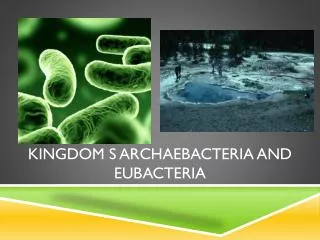
Delve into the world of Archaebacteria and Eubacteria, the oldest known life forms on Earth with unique characteristics. Explore their structures, growth patterns, classification, and roles in the ecosystem, from beneficial to pathogenic bacteria. Learn about antibiotics, cellular respiration, reproduction methods, and more.

E N D
Characteristics • First living evidence on earth • Unicellular • Prokaryotes (No membrane-bound organelles) • Cell wall with internal plasma membrane • Found everywhere
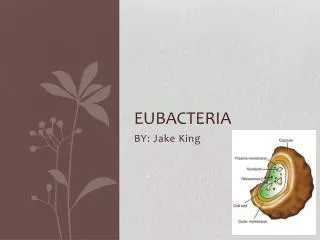
Bacteria Structures • Cell wall – provides support and protection to the cell • Plasma membrane – flexible, selectively permeable boundary that controls what enters and leaves the cell • Cytoplasm – semi-fluid material inside the cell’s plasma membrane • Ribosome – organelle that helps to manufacture proteins • DNA - stores and communicates genetic information for the cell
Bacteria Structures • Pilus/pili - hairlike protrusion • to stick to surfaces • a bridge for sexual reproduction • Flagellum - long, whiplike protrusion, for moving • Capsule - sticky layers around cell wall • Toxin - a powerful poison • Endospore – found in some bacteria - resists harsh environments
Classification:Three Basic Shapes • Cocci -SpheresBacilli -RodsSpirilli -Spiral
Classification: • Gram stain – Cell wall type • Thick – Purple Stain = “Gram Positive” • Thin - Pink Stain = “Gram Negative”
Growth Patterns • Diplo- pairs • Staphylo- clusters • Strepto- chains
Live in more habitable environments Eubacteria - “True” bacteria
Beneficial Bacteria • Nitrogen fixation • Converts nitrogen into ammonia • a form that plants can use • Nodules • A symbiotic relationship between bacteria and plants
(Beneficial Bacteria) Saprophytes (decomposers) • Breaks down dead organisms and decaying matter • Returns nutrients to soil
(Beneficial Bacteria) Make food: • Cheese • Pickles • Yogurt • Vinegar • Sauerkraut
Pathogenic Bacteria – disease-causing bacteria • Pathogen – an organism that causes disease • Produce toxins • Damage host’s tissues • Enter through openings in body (via air, food, water)
Antibiotics:~ Destroys cell wall of bacteria~ Creates holes in the cell walls Sir Alexander Fleming1928 - discovered Penicillium notatum
Reproduction Asexual • Binary Fission • Cell division • Rapid - 20 min. Sexual • Conjugation – exchange genetic material • Pili/pilus - bridge