Download
1 / 7
70 likes | 183 Vues
Explore the transformation of Barracks Row, a vibrant commercial corridor on Capitol Hill, and discover the significance of walkability for businesses. As urban areas grow, the demand for pedestrian-friendly spaces increases, impacting customer flow and the overall success of local businesses. Learn how Barracks Row adapted its infrastructure, emphasizing multi-modal transit and the need for bike lanes and wider sidewalks. It's essential to plan for future needs to foster a thriving community that attracts residents and visitors alike.

E N D
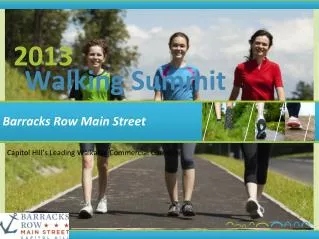
Barracks Row Main Street Capitol Hill’s Leading Walkable Commercial Corridor Picture orLogo Here
Martin Smith Executive Director Subtitle Here Picture orLogo Here
Who Works with Walkable Commercial Districts? • What is a “Main Street”? • What is a “Business Improvement District”? • What are the general organizing principles of vibrant commercial districts? • Multi-modal transit • Responsive to consumer transportation choices • Example: Delivery of products / services • Focus on pedestrian scale • Solid mix of restaurants / retailers / services / residents Picture orLogo Here
Walkability and Business • Why is walkability important to business owners? • DC and other major cities have a high rate of car-free households, and this number is growing among young families • Parking can be a challenge in urban areas, so walkability benefits drivers as well - park once and run several errands in a walkable corridor instead of driving from store to store • Pedestrian orientation lets businesses draw in more customers overall - window displays are far more visible to a pedestrian than a driver • Walkable corridors also draw in more occasional customers - consumers choose convenience and will use a business that is already on the route they take between a destination and a transit option they plan to use Picture orLogo Here
Lessons from Barracks Row • Barracks Row had a complete streetscape rebuild in 2005 • As part of this rebuild, parking on the east side of the street was angled to add additional spaces • This meant there was not enough space for bike lanes, which could have been provided with standard curbside parking on the east side • Standard curbside parking would also have left additional space that could have been used for wider sidewalks and bigger sidewalk cafes Picture orLogo Here
Lessons from Barracks Row • Plan for the future!! • As the corridor has evolved, we have a new need for bike facilities • We also have five times as many sidewalk cafes now as we did in 2005 when the street was rebuilt • Plan for the street you want, not one that meets your current needs • If budgets are limited, at least plan for a “Phase 2” option even if it will not be implemented right away Picture orLogo Here
FULL FRAME BACKGROUND Picture orLogo Here