Download

1 / 12
130 likes | 239 Vues
This presentation explores the principles of lift and drag in aviation, focusing on Bernoulli's Principle, which states that an increase in a fluid's speed results in a decrease in pressure. It explains the relationship between angle of attack, lift, and drag, demonstrating how lift increases while drag also rises as the angle of attack increases. The presentation covers important concepts such as the coefficient of lift and drag, airfoil shapes, relative airflow, and the functions of airfoils, providing a comprehensive understanding of aerodynamic forces.

E N D
406.05 Lift 40 mins OCdt Marleau
Bernoulli’s Principle • An increase in the speed of a fluid occurs simultaneously with a decrease in pressure or a decrease in the fluid's potential energy.
Angle of Attack • As the angle of attack increases, what happens to lift? Lift Increases • As the angle of attack increases, what happens to drag? Drag Increases
Lift and Drag Curves Page 2F-1 in your 242
Lift/Drag Ratio • The coefficient of lift and the coefficient of drag depend on the shape of the airfoil and the angle of attack. Lcoefficient of lift D coefficient of drag
Airfoil A surface designed to obtain a reaction from the air through which it moves. (2 dimensional) Airfoil – 2D Wing – 3D
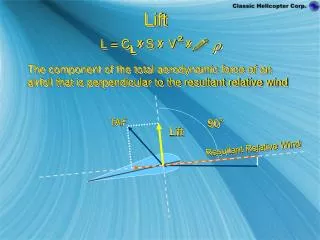
Relative Airflow • The direction of the airflow with respect to the wing. • It is created by the movement of the airplane as well as the movement of air. • Relative airflow is usually opposite to the flight path.
Angle of Attack • The angle at which the airfoil meets the relative airflow.
Functions of Airfoils • Create lift • Create thrust • Attachment point for the control surfaces (including flaps, slots, slats, etc) • House fuel tanks and instrument components • Stability
What We Have Learned • Bernoulli’s Theorem • Variation of Lift and Drag with A of A • Lift/ Drag Ratio • Relative Airflow and Angle of Attack • Pressure Distributions • Functions of Airfoils