Exploring Connectionist Models in Cognitive Science: Insights on Animal Hierarchy and Memory
This document examines connectionist modeling in cognitive science, demonstrating its relevance through the example of cats and the hierarchical representation of animals. It discusses the attributes of vertebrates, including mammals, birds, and fish, and addresses concepts like cognitive economy, prototypicality, and familiarity effects. The paper contrasts traditional hierarchical models with connectionist approaches, which incorporate strong and weak links among concepts. Additionally, it highlights the significance of connectionist models in understanding both intact and impaired memory systems.

Exploring Connectionist Models in Cognitive Science: Insights on Animal Hierarchy and Memory
E N D
Presentation Transcript
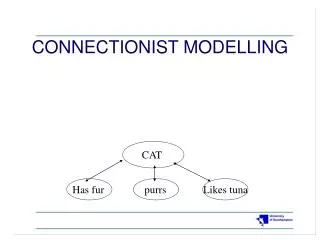
CONNECTIONIST MODELLING CAT Has fur purrs Likes tuna
CONNECTIONIST MODELLING ANIMALS Vertebrates Amphibians Fish Mammals Birds Reptiles CAT Has fur purrs Likes tuna
Notion of Cognitive Economy alive sleeps reproduces eats Animal Vertebrate has a spine fly lay eggs feathered Birds Mammals have milk live young have hair Robin Penguin Cat
Evidence FOR • Sentence verification speed: • - quicker to verify across fewer levels of hierarchy (Schwartz & Reisberg, 1991) Evidence AGAINST • Prototypicality effect – a robin is a bird; a penguin is a bird • Familiarity effect – a cat is an animal; a cat is a mammal
alive sleeps reproduces eats Animal Vertebrate has a spine fly lay eggs feathered Birds Mammals have milk live young have hair Robin Penguin Cat Notion of Cognitive Economy
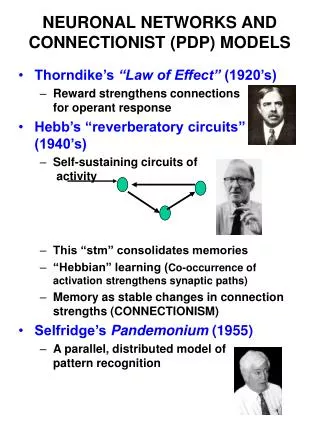
Resolution: The Development of Connectionist Models (Collins & Loftus, 1973) • Abandon hierarchy • Introduce concept of strong and weak links Strong = familiarity/prototypical exemplars Weak = unfamiliar/non-prototypical exemplars
Bruce and Young (1986):Information Processing Model View-Centred Descriptions Expression Analysis Structural Encoding Expression-Independent Descriptions Facial Speech Analysis Face Recognition Units Directed Visual Processing Person-Identity Nodes “Cognitive System” Name Generation
Burton, Bruce & Johnston, (1991): Interactive Activation and Competition Model FRUs ‘tony’ ‘paul’ ‘john’ ‘bill’ SIUs Singer politician British American Dead Alive President PM ‘Beetle’ NAMES Bill Clinton John Lennon Tony Blair Paul McCartney
Burton, Bruce & Johnston, (1991): Interactive Activation and Competition Model + + + + ++++ + +++ FRUs ‘tony’ ‘paul’ ‘john’ ‘bill’ SIUs Singer politician British American Dead Alive President PM ‘Beetle’ NAMES Bill Clinton John Lennon Tony Blair Paul McCartney
Burton, Bruce & Johnston, (1991): Interactive Activation and Competition Model + + + + ++++ + +++ PROSOPAGNOSIA ‘tony’ ‘paul’ ‘john’ ‘bill’ SIUs Singer politician British American Dead Alive President PM ‘Beetle’ NAMES Bill Clinton John Lennon Tony Blair Paul McCartney ANOMIA
SUMMARY: The Value of the Connectionist Approach • It offers a very powerful model of memory • It possesses cognitive economy • It possesses biological plausibility • It can model both intact memory and impaired memory • It can model simple semantic memory and more complex real-world memory • It provides a model of how information is stored and how it is retrieved.