Download
1 / 1
10 likes | 121 Vues
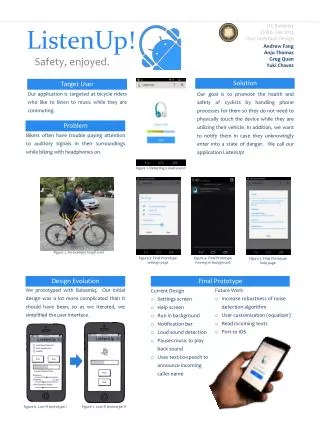
ListenUp! is an innovative application designed for cyclists who enjoy listening to music while commuting. Our objective is to enhance the health and safety of cyclists by managing phone processes hands-free, reducing the need for physical interaction with devices while riding. The app alerts users when they unknowingly enter potentially dangerous situations, helping them stay aware of their surroundings. Features include loud sound detection, automatic music pausing, and text-to-speech notifications for incoming calls. Our design evolution focused on simplifying the user interface for a better experience.

E N D
UC Berkeley CS160 Fall 2014 User Interface Design ListenUp! Andrew Fang Anju Thomas Greg Quan Yuki Chavez Safety, enjoyed. Target User Solution Target User Our application is targeted at bicycle riders who like to listen to music while they are commuting. Our goal is to promote the health and safety of cyclists by handling phone processes for them so they do not need to physically touch the device while they are utilizing their vehicle. In addition, we want to notify them in case they unknowingly enter into a state of danger. We call our application ListenUp! Problem Problem Bikers often have trouble paying attention to auditory signals in their surroundings while biking with headphones on. Figure 1. Detecting a loud sound Figure 2. An example target user Figure 3. Final Prototype settings page Figure 4. Final Prototype running in background Figure 5. Final Prototype help page Design Evolution Design Evolution Final Prototype We prototyped with Balsamiq. Our initial design was a lot more complicated than it should have been, so as we iterated, we simplified the user interface. • Future Work • Increase robustness of noise detection algorithm • User customization (equalizer) • Read incoming texts • Port to iOS • Current Design • Settings screen • Help screen • Run in background • Notification bar • Loud sound detection • Pauses music to play back sound • Uses text-to-speech to announce incoming caller name Figure 6. Low-Fi prototype I Figure 7. Low-Fi prototypeII