Understanding Lewis Structures and Valence Electrons in Atoms
Lewis structures provide a visual representation of atoms and their valence electrons, which are crucial in forming compounds. Valence electrons are those in the outermost orbit and are illustrated as dots around the element's symbol. Each element's symbol represents its protons, neutrons, and inner electrons, while complementary dots are arranged to show the arrangement of electrons. To quickly determine the number of valence electrons, refer to the element's group number on the periodic table, excluding transition metals. Examples include Sodium (Na), Fluorine (F), and Calcium (Ca).


Understanding Lewis Structures and Valence Electrons in Atoms
E N D
Presentation Transcript
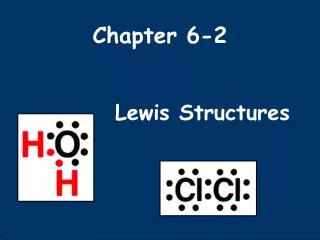
Lewis Structures • When atoms form compounds valence electrons are the ones that are involved • Valence electrons are the electrons found in the outermost orbit • Lewis structures show atoms depicting their valence elecetrons only– much easier.
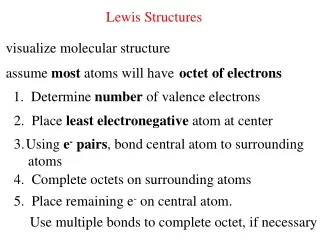
Rules • Symbol of the element is in the center (represents protons, neutrons, and inner electrons– electrons not in outer orbit) • The symbol is assumed to have 4 sides, and the electrons in the outermost energy level are placed as dots on the four sides. • Dots are placed singly, and are then paired up (N S E W).
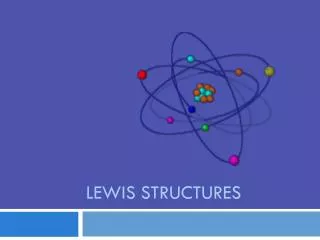
Valence electrons are the electrons in the outer orbit surrounding an atom in a Bohr-Rutherford Diagram What is the shortcut to finding the number of valence electrons?
How to Remember?? • Find the group number the element is in while skipping the transition metals.
Samples Sodium Fluorine Calcium Na F Ca