Lewis Structures
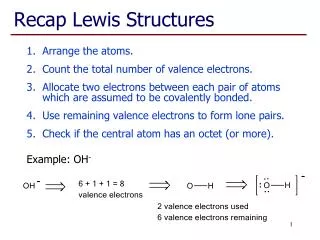
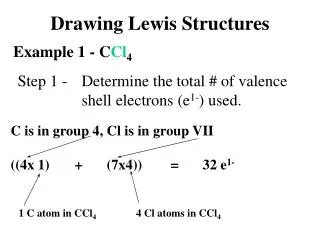
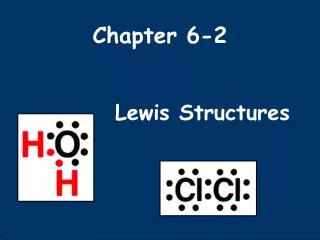
Lewis dot diagrams are a visual representation of atoms and their valence electrons, focusing only on the electrons involved in bonding and omitting the nucleus. They help predict how elements bond based on their valence electron count, which can be identified from the periodic table. For example, elements in group 1 have 1 valence electron, while those in group 18 have 8 (except helium, which has 2). Create your own diagrams for lithium, chlorine, boron, and nitrogen to practice this important concept.


Lewis Structures
E N D
Presentation Transcript
Lewis Dot Diagrams • This is another way to represent ATOMS and THEIR ELECTRONS. • ONLY SHOWS ELECTRONS OF THE ATOMS, NO NUCLEUS 2. These diagrams help you predict how ELEMENTS bond. 3. A diagram consists of the element’s symbol and dots representing the VALENCE electrons in an atom
Remember?? • We KNOW the NUMBER of VALENECE elections based on the LOCATION IN THE PERIODIC TALBE • Elements in group 1 have 1 valence electron. • Elements in group 2 have 2 valence electrons. • Elements in group 13 have 3 valence electrons. • Elements in group 14 have 4 valence electrons. • Elements in group 15 have 5 valence electrons. • Elements in group 16 have 6 valence electrons. • Elements in group 17 have 7 valence electrons. • Elements in group 18 have 8 valence electrons. THE EXCEPTION IN THIS GROUP IS HELIUM; IT ONLY HAS 2 VALENCE ELECTRONS.
Lewis Structure Example: CARBON Bohr Diagram
Your turn… • In your notes, draw the Lewis Structures for the following elements: • Lithium • Chlorine • Boron • Nitrogen