Enhancing Support for At-Risk Students with Tier 2 Interventions
700 likes | 819 Vues
This guide explores the implementation of Tier 2 interventions aimed at supporting at-risk students in academic and behavioral domains. It focuses on proactive strategies that supplement universal supports and improve classroom structures, predictability, and routines. Key concepts include defining clear expectations, active supervision, and providing multiple opportunities for success. Examples like Check-in/Check-out (CICO) highlight how consistent monitoring and positive reinforcement can lead to improved student outcomes. This approach helps catch potential crises early and fosters a supportive learning environment.


Enhancing Support for At-Risk Students with Tier 2 Interventions
E N D
Presentation Transcript
The At-Risk Student: Special Education Services: Looking deeper: accommodations and supports Good teaching
Tier 2: Behavior/Academic Interventions • Strategies or techniques • designed to teach a new skill • build fluency in a skill • to encourage application of a skill a student has to a new situation
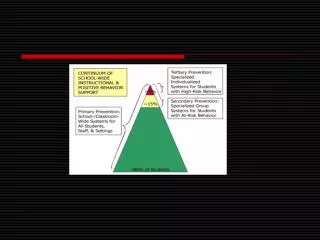
Who needs Tier 2? • Student “at risk” for academic or behavior concerns • Universal supports/good teaching is not enough • Monitoring needed • Catch ‘em before a crisis
Tier 2 Key concepts: • Preventative • Targeted (but not individualized) • Improved structure, predictability and routine • Generalizable to new situations • Positive • Supports classroom teacher
Tier 2 builds on your effective classroom practices: • Clearly defined expectations and rules • Clearly defined procedures and routines • Continuum of strategies • Acknowledge appropriate responses • Respond to inappropriate responses • Active supervision • Multiple opportunities to respond Choices • Opportunities for success
Tier 2 Examples: • Check in/Check out • Small group social skill building • Group counseling • Mentoring programs
Check-in Check-out (CICO) • Remember “Anderson Elementary”? • Be safe • Be responsible • Be respectful
Major Features of Targeted Interventions • Intervention is continuously available • Very low effort by teachers • Consistent with school-wide expectations • Implemented by all staff/faculty in a school • Home/school linkage • Flexible intervention based on assessment • Student chooses to participate
BEP Plan Weekly BEP Meeting 9 Week Graph Sent Morning Check-In Program Update Home Check-In EXIT Afternoon Check-out Check-in Check-out Cycle Class Check out TeacherChecks Class Check in
CICO Record Name: ____________________________ Date: ______________ 0 = Need work, 1 = “OK” 2 = Nice Job Comments:
HAWK Report Date ________ Student _______________Teacher___________________
Why does CICO work? • Improved structure • Prompts throughout the day for correct behavior. • Links student with at least one positive adult. • Student chooses to participate. • Student is “set up for success” • First contact each morning is positive. • First contact each period is positive, and sets up successful behavioral momentum. • Increase in contingent feedback • Feedback occurs more often. • Feedback is tied to student behavior. • Inappropriate behavior is less likely to be ignored or rewarded.
Why does CICO Work? • Program can be applied in all supervised school locations • Elevated reward for appropriate behavior • Adult and peer attention delivered each target period • Adult attention (and tangible) delivered at end of day • Linking school and home support • Provide format for positive student/parent contact • Program is organized to morph into a self-management system • Increased options for making choices • Increased ability to self-monitor performance/progress
Logistics for Setting up a CICO program • Faculty and staff commitment • Is problem behavior a major concern? • Are staff willing to commit 5 min per day? • Is CICO a reasonable option for us? • More than 5 students need extra support • CICO is designed to work with 10-12% of kids in a school • CICO typically “works” with 67% of students. • CICO does NOT replace need for individualized supports.
Logistics for Setting up a CICO program • School-wide PBS in place • School-wide expectations defined and taught • Reward system operating • Clear and consistent consequences for problem behavior • Process for identifying a student who may be appropriate for CICO • Student is not responding to SWPBS expectations • Student finds adult attention rewarding • Student is NOT in crisis.
Logistics for Setting up a CICO program • Daily CICO progress report card • Same expectations for all • Common schedule • All staff taught rules for accepting, completing and returning the card. • Home report process • Can be same as progress card • Can be a unique reporting form
CICO Home Report Name: _____________________________ Date: _____________ ______ I met my goal today ______ I had a hard day One thing I did really well today was:_______________________ Something I will work on tomorrow is: _______________________ Comments: Parent/Guardian Signature: ________________________________________________________ Comments:
Logistics for Setting up a CICO program • Trading menu • Reward for collecting and turning in daily progress card • Reward for meeting daily goal • Exchange system for points earned • Collecting, summarizing and using data • Daily updates • Weekly review by team • Refer for tier 3 if necessary 28
At the top of the triangle… “Level 3” Intensive supports (5%) Individualized, targeted supports Functional Behavior Assessment Behavior Support Plan
You can see a lot by looking~yogi berra • http://www.challengingbehavior.org/explore/pbs/case_studies.htm • Video 1: What do you see?
FromFunctional Behavior Assessment (FBA) toPositiveBehavior Support Plan Featuring… a little guy named “Brendan”
Steps of an FBA to lead to PBSP: • Describe and verify the seriousness of the problem • Refine the definition of the problem behavior • Collect information on the possible functions of the problem behavior • Analyze the information • Generate an hypothesis about the function of the problem behavior • Test the hypothesis • Develop a plan
Who’s involved? • Informal FBA: • Teachers and staff • Indirect/Simple FBA: • Teachers/staff and School Specialist • Complex FBA: • Teachers/staff, School Specialist and Behavior Specialist • Always with Parental Consent!
When do we need to conduct an FBA? • IEP team decision • Manifestation of a student’s disability • When student is referred to law enforcement • When a student is removed from his/her current placement • Weapons violation • Drug possession/use • Bodily injury • Suspension without manifestation of disability
Describe and verify the seriousness of the problem • http://www.challengingbehavior.org/explore/pbs/case_studies.htm • Getting started: • Brendan’s Functional Assessment interview
Refine the definition of the problem behavior • Brendan is aggressive • Clarify! • Brendan misbehaves in public • Clarify! So Grandma can see it!
Collect information on the possible functions of the problem behavior • Brendan’s observation cards • http://www.challengingbehavior.org/explore/pbs/case_studies.htm
“What is he doing THAT for?” • Change our focus from what to why • “WHY does the child need to do this?” • Escape/avoid • Attention/access • Combination! • Communication • All behavior serves a purpose!
And after we know “WHY”… • We look at replacing the inappropriate behavior with a more suitable behavior that serves the same function (or results in the same outcome) as the problem behavior
Analyze the information • Generate an hypothesis about the function of the problem behavior • Brendan’s hypothesis statements http://www.challengingbehavior.org/explore/pbs/case_studies.htm
Why should Brendan change his behavior? • students will change the inappropriate behavior only when it is clear to them that a different response will more effectively and efficiently accomplish the same thing!
Test the hypothesis • Develop a plan • Steps to Developing and Implementing a Behavior Support Plan
Brendan’s behavior support plan • Review and revise as needed • http://www.challengingbehavior.org/explore/pbs/case_studies.htm
Informal…Case Study: "Blue Ink Line" • The Incident • Background Information
Remember: “An ounce of prevention is…” • What would be your “Ten Commandments” of managing a crisis?
Your Task • Read the Incident • No FBA yet: act fast! • Think about your immediate intervention; • How would you ensure physical safety? • How would you attend to the emotional well-being of those most centrally involved? • How would you return the setting to order and peace?
Ensuring Physical Safety: • Preventing a crisis: • An ounce of prevention… • Teacher tension can often make it worse • Always remain calm • Lower your voice • Slow your rate of speech • Arrange your environment to eliminate risk
Give the student space • Be aware of your body stance • Dress in a manner that minimizes injury risk • Remind students of consequences of misbehavior • Allow verbal venting • Ignore irrelevant comments. Redirect student to the problem at hand
Provide choices • Set limits • Use physical restraint as a last resort • Once the situation is calm, use the incident to teach alternative appropriate ways to deal with aggression.
Long-Term Intervention • Make a decision as to whether to act further • Do you need to promote a lasting, positive behavior change? • Try this: role play the FBA interview
Steps to Long-Term Intervention: an Informal FBA • Assess the problem: • What’s the behavior you want to target? • What are the antecedents? Consequences? Settings? • When/where is the behavior most likely to occur? When/where is it least likely? • What information can you gather from the family?
Formulate objectives of intervention • What is your team’s hypothesis? • When this happens (antecedent)____, Celia does this (behavior)___, in order to (get or avoid/function) this___, and we should do this ______. • Plan an effective intervention • Implement the intervention • Evaluate the results, revise plan if needed.
Why use visual strategies? • To help prevent problem behavior before it starts • To support and increase communication • To remind • They’re always there • Help kids know exactly what you expect • Teach routine • Work well with spoken/sign language • Just another cue!
What is a Social Story? • A short story – defined by specific characteristics • Describes a situation, concept, or social skill • Uses a format that is meaningful for people with ASD or other developmental disabilities.
What is a Social Story? • Goals: • renewed sensitivity of others to the experience of the person with ASD (or other disabilities), • Helps to develop “social cognition”
Who Writes Social Stories? • Social Stories are written by people who work and/or live with people with ASD or other disabilities. • Some prewritten stories exist